Post Reply
1-9 of 9
Post Reply
1-9 of 9
Seatrium secures FSRU conversion contract from Norway&rsquo s Hoegh Evi
Seatrium has secured a floating storage regasification unit (FSRU) conversion contract from Norway&rsquo s Hö egh Evi, a global leader in floating energy infrastructure. The company is said to have one of the world&rsquo s largest fleets of FSRUs for importing natural gas.
The contract will cover the conversion and longevity of liquefied natural gas (LNG) carrier, Hoegh Gandria, to a FSRU. This includes the installation of a regasification skid, as well as integration of key supporting systems such as cargo handling, utility, offloading, electrical, and automation systems.
The group will begin engineering works in May, with the project expected to take about 18 months to complete.
Upon its completion, the FSRU LNG will be deployed to the LNG terminal in Port of Sumed, Egypt under a charter agreement between Hoegh Evi and Egypt Natural Gas Holding Company (EGAS).
pakistan india war cause oil price to go up. i think so
The oil and natural gas market dynamics described in the forecast are likely to have significant implications for industries like SEMCBROP (possibly referring to energy or industrial sectors), SIA (potentially a company or industry related to aviation, shipping, or another global logistics sector), and Seatrium (possibly in the aviation or energy sector, based on the name). Here' s a breakdown of how these forecasted price movements could affect them:
1. SEMCBROP Industry (Energy or Industrial Sectors)
- Oil Price Impact: A price decline in WTI and Brent crude oil due to OPEC+' s output hike could reduce operating costs for energy-intensive industries. If oil prices drop or stagnate, businesses in sectors like energy production, manufacturing, and transportation (if SEMCBROP refers to industrial operations) might benefit from lower input costs for energy and fuel.
- Natural Gas Outlook: With natural gas prices holding above $3.99, the bullish outlook (especially if it breaks $4.23) suggests a higher cost of natural gas for industries reliant on it for heating, power, or raw materials. This could squeeze margins for businesses in sectors like manufacturing, chemicals, and power generation.
2. SIA (Aviation, Shipping, or Logistics Sector)
- Aviation and Shipping: If SIA refers to an aviation or shipping company (common for such acronyms), the impact of rising oil and gas prices (particularly jet fuel and bunker fuel) is significant. With oil prices under pressure, aviation companies (and shipping industries) may see reduced fuel costs in the short term, which would improve profitability. However, if tariffs on trade (U.S. tariffs on Canadian, Mexican, and Chinese imports) reduce global economic activity, there could be slower growth in air and sea cargo demand.
- Fuel Surcharge Adjustments: The volatility in fuel costs could lead airlines or shipping companies to adjust their fuel surcharges to maintain profitability. If oil prices keep fluctuating or drop further, it could reduce the overall financial strain on fuel-heavy industries like aviation.
3. Seatrium (Energy or Aviation-related Sector)
- Impact on Energy Costs: Assuming Seatrium operates in the energy, aviation, or related sectors, they would feel the effects of energy price volatility. A price decrease in oil and gas could reduce operational costs for airlines, ship operators, or even energy-dependent industries, allowing them to hedge against high operational costs in uncertain economic times.
- Market Sentiment: The weakening economic outlook, with the potential tariff impact, could dampen demand for both energy and transportation services. However, if Seatrium is tied to sectors that directly benefit from low oil prices (e.g., maintenance and repair services for aircraft or energy production), lower fuel prices would likely reduce operational costs and increase demand for their services.
4. Geopolitical and Economic Risks
- Tariffs and Economic Slowdown: The new U.S. tariffs on imports could create a slowdown in economic growth, especially affecting industries dependent on cross-border trade, including manufacturing and transportation. While energy prices may dip, this slower economic activity could offset any potential benefits from lower oil prices.
In Conclusion:
- Short-term Benefits: Lower oil prices could reduce operational costs for energy-intensive industries (SEMCBROP, aviation, shipping).
- Long-term Concerns: The economic slowdown resulting from tariffs could dampen demand for goods and services, especially in global trade and transportation, affecting sectors like SIA and Seatrium. Additionally, the bullish natural gas outlook could add cost pressure in the energy-intensive sectors.
Ultimately, the effects on SEMCBROP, SIA, and Seatrium depend on their direct exposure to fuel costs and how they are positioned in the broader global economy, particularly with the risks posed by tariffs and geopolitical uncertainties.
dontbetray ( Date: 05-Mar-2025 14:17) Posted:
Natural Gas and Oil Forecast: Will OPEC+ Output Hike Trigger a Price Collapse?
Updated: Mar 04, 2025, 12:55 GMT+00:00
Key Points:
- OPEC+ confirms a 138,000 bpd output hike in April, raising concerns of oversupply and adding pressure to global oil prices.
- New U.S. tariffs on Canadian, Mexican, and Chinese imports could slow economic activity and weaken energy demand.
- Natural gas holds above $3.99, with buyers stepping in&mdash breakout above $4.23 could signal bullish momentum.
Market Overview
Oil prices extended losses as OPEC+ confirmed a planned output hike of 138,000 barrels per day in April&mdash the group&rsquo s first increase since 2022&mdash raising concerns of oversupply. Additional pressure came from new U.S. tariffs, with a 25% levy on Canadian and Mexican imports and an increase on Chinese goods to 20%.
Analysts warn these measures could slow economic activity and dampen fuel demand. Meanwhile, geopolitical tensions continue to influence market sentiment, particularly regarding potential shifts in Russian energy flows.
Despite speculation over sanctions relief, Goldman Sachs suggests Russia&rsquo s supply remains more constrained by OPEC+ targets than external restrictions.
Natural Gas Price Forecast
Natural Gas (NG) Price Chart
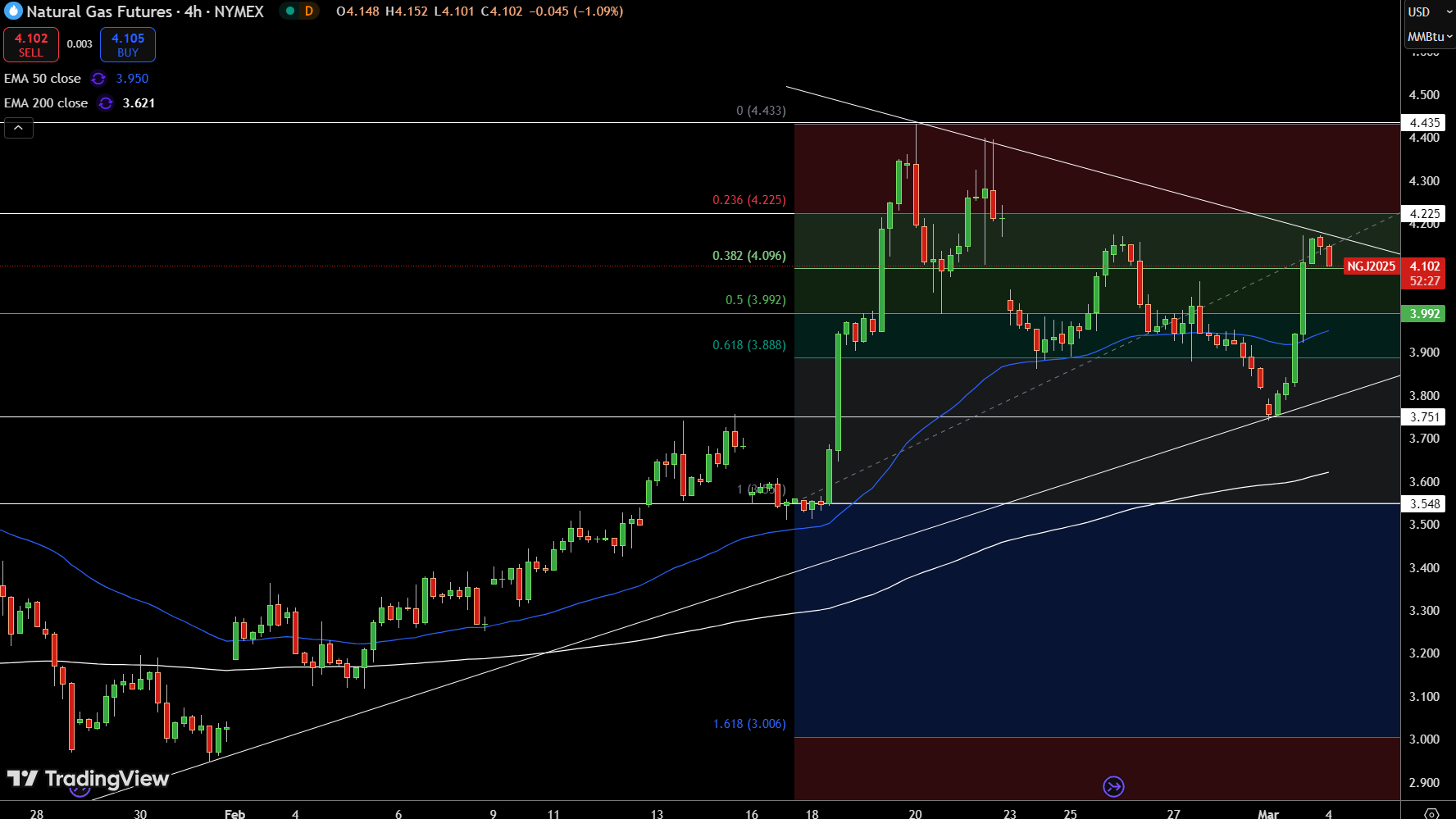
At $4.10, the price of Natural Gas (NG) is hovering just above its pivot point of $3.99, signaling a critical inflection zone. The 50-day EMA at $3.95 provides a near-term floor, while the 200-day EMA at $3.62 underscores a broader uptrend. A sustained hold above $3.99 keeps the bullish structure intact, with immediate resistance at $4.23 and a more significant hurdle at $4.44.
However, a break below $3.99 could shift momentum, triggering a move toward $3.75 or even $3.55. The current consolidation suggests buyers are stepping in, but a definitive push past $4.23 would confirm strength.
WTI Oil Price Forecast
WTI Price Chart
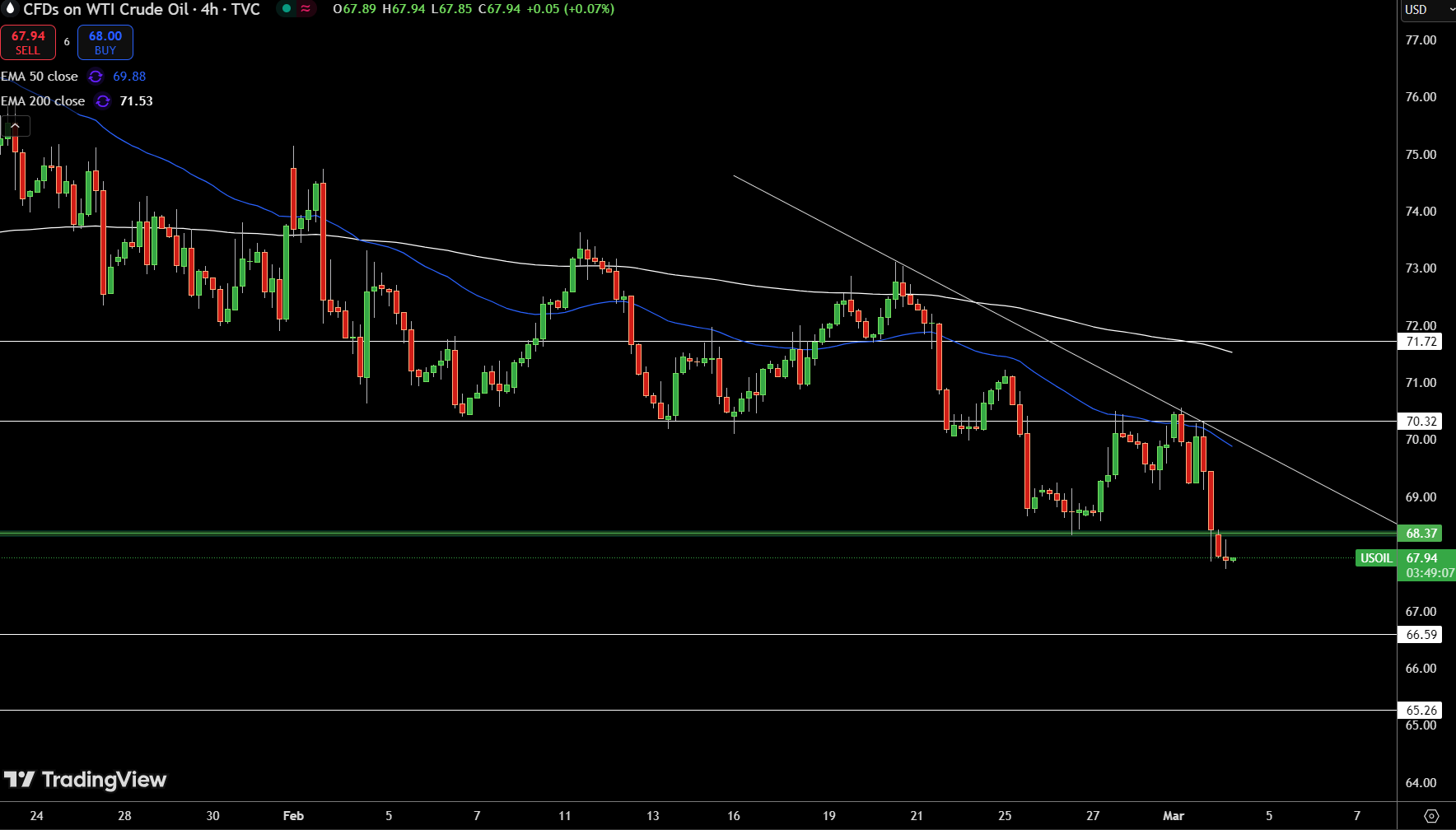
U.S. crude (USOIL) is treading water at $68.01, sitting just below its pivot point of $68.37. The technical setup leans bearish in the short term, with the 50-day EMA at $69.88 acting as overhead resistance and the 200-day EMA at $71.53 reinforcing a broader downtrend.
A failure to reclaim $68.37 could push prices lower, with immediate support at $66.59 and deeper downside risk toward $65.26. On the flip side, a decisive break above $68.37 could shift momentum, setting the stage for a move toward $70.32.
Traders should watch for volume confirmation&mdash if buyers step in above resistance, it could signal renewed upside, but continued weakness below $68.37 may keep oil under pressure.
Brent Price Chart
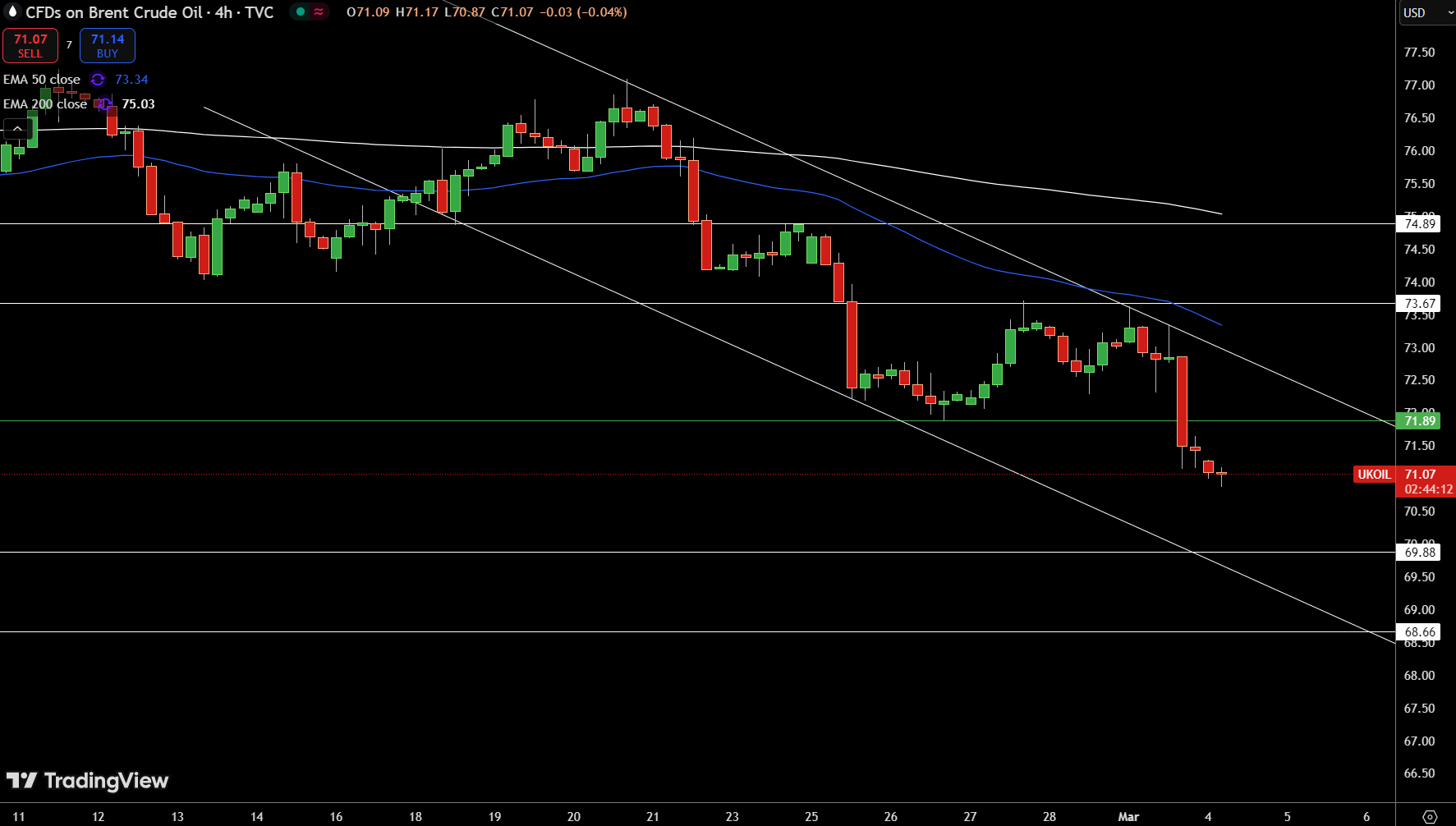
Brent crude (UKOIL) is trading at $71.06, dipping just below its pivot point of $71.89 and signaling potential weakness. The 50-day EMA at $73.34 and the 200-day EMA at $75.03 suggest a bearish bias in the broader trend. If prices fail to reclaim $71.89, sellers may push the market lower, with immediate support at $69.88 and further downside risk toward $68.66.
However, a break above $71.89 could shift sentiment, targeting resistance at $73.67 and potentially $74.89. The price action remains in a tight range, with traders looking for confirmation. A sustained move above resistance could trigger buying interest, while continued weakness below $71.89 may keep Brent under pressure in the near term
|
|
Natural Gas and Oil Forecast: Will OPEC+ Output Hike Trigger a Price Collapse?
Updated: Mar 04, 2025, 12:55 GMT+00:00
Key Points:
- OPEC+ confirms a 138,000 bpd output hike in April, raising concerns of oversupply and adding pressure to global oil prices.
- New U.S. tariffs on Canadian, Mexican, and Chinese imports could slow economic activity and weaken energy demand.
- Natural gas holds above $3.99, with buyers stepping in&mdash breakout above $4.23 could signal bullish momentum.
Market Overview
Oil prices extended losses as OPEC+ confirmed a planned output hike of 138,000 barrels per day in April&mdash the group&rsquo s first increase since 2022&mdash raising concerns of oversupply. Additional pressure came from new U.S. tariffs, with a 25% levy on Canadian and Mexican imports and an increase on Chinese goods to 20%.
Analysts warn these measures could slow economic activity and dampen fuel demand. Meanwhile, geopolitical tensions continue to influence market sentiment, particularly regarding potential shifts in Russian energy flows.
Despite speculation over sanctions relief, Goldman Sachs suggests Russia&rsquo s supply remains more constrained by OPEC+ targets than external restrictions.
Natural Gas Price Forecast
Natural Gas (NG) Price Chart
At $4.10, the price of
Natural Gas (NG) is hovering just above its pivot point of $3.99, signaling a critical inflection zone. The 50-day EMA at $3.95 provides a near-term floor, while the 200-day EMA at $3.62 underscores a broader uptrend. A sustained hold above $3.99 keeps the bullish structure intact, with immediate resistance at $4.23 and a more significant hurdle at $4.44.
However, a break below $3.99 could shift momentum, triggering a move toward $3.75 or even $3.55. The current consolidation suggests buyers are stepping in, but a definitive push past $4.23 would confirm strength.
WTI Oil Price Forecast
WTI Price Chart
U.S. crude (
USOIL) is treading water at $68.01, sitting just below its pivot point of $68.37. The technical setup leans bearish in the short term, with the 50-day EMA at $69.88 acting as overhead resistance and the 200-day EMA at $71.53 reinforcing a broader downtrend.
A failure to reclaim $68.37 could push prices lower, with immediate support at $66.59 and deeper downside risk toward $65.26. On the flip side, a decisive break above $68.37 could shift momentum, setting the stage for a move toward $70.32.
Traders should watch for volume confirmation&mdash if buyers step in above resistance, it could signal renewed upside, but continued weakness below $68.37 may keep oil under pressure.
Brent Price Chart
Brent crude (
UKOIL) is trading at $71.06, dipping just below its pivot point of $71.89 and signaling potential weakness. The 50-day EMA at $73.34 and the 200-day EMA at $75.03 suggest a bearish bias in the broader trend. If prices fail to reclaim $71.89, sellers may push the market lower, with immediate support at $69.88 and further downside risk toward $68.66.
However, a break above $71.89 could shift sentiment, targeting resistance at $73.67 and potentially $74.89. The price action remains in a tight range, with traders looking for confirmation. A sustained move above resistance could trigger buying interest, while continued weakness below $71.89 may keep Brent under pressure in the near term
by right, seatrium shud benefit at the expenses of yzj ship.
it dont have china exposure
BOUGHT TO YOU BY JUSTIN BIEBER
Baby Baby for baby drill baby
https://www.instagram.com/reel/DFjyg2UzLRm/?igsh=MXVzamZxdjQ2ZW5ycQ==
stay calm. if dont know, do research . dont buy dip for sake of buy dip
Trump's 'drill baby drill' inspires UOB Kay Hian to maintain 'overweight' view on offshore and marine counters
Mon, Feb 03, 2025 ? 06:20 PM GMT+08
Trump's 'drill baby drill' inspires UOB Kay Hian to maintain 'overweight' view on offshore and marine counters
UOB Kay Hian has kept its "overweight" view on the region's offshore and marine sector, given how the Trump presidency is rehashing the "drill baby drill" mantra.
"Increasingly, it appears that ?fossil fuels? could become less of a bad phrase in the next four years," says analyst Adrian Loh in his Feb 3 note.
The resultant higher levels of global offshore activity would presumably lead to "tightness" in the market and thereby push up rates for rigs and offshore support vessels, he reasons.
behonest ( Date: 09-Feb-2025 18:03) Posted:
how Trump' s " Drill, Baby, Drill" policy might benefit Seatrium, a company specializing in marine and offshore services, particularly focusing on shipbuilding, offshore structures, and repair services.
Here&rsquo s how a policy like " Drill, Baby, Drill," which promotes increased oil and gas production, could potentially benefit Seatrium:
-
Increased Demand for Offshore Drilling Platforms: With more drilling activity, especially in offshore areas, there would likely be an increased need for offshore drilling platforms and rigs. Seatrium, which is involved in offshore and marine engineering, could see increased demand for building and maintaining these platforms.
-
Maintenance and Repair Services: More oil and gas drilling activity could lead to higher demand for maintenance and repair services for offshore rigs and vessels. Seatrium, with its expertise in ship and offshore structure repair, could experience growth in its repair and maintenance business.
-
Marine Infrastructure Development: The " Drill, Baby, Drill" policy could encourage the development of more oil and gas infrastructure, including new drilling rigs, support vessels, and refueling stations. Seatrium could potentially secure contracts for building or servicing such infrastructure.
-
Increased Energy Sector Spending: The policy could lead to more investment in the oil and gas sector, which might spill over into increased spending on related services, including marine support. Seatrium could benefit if energy companies allocate more budget to upgrading and expanding their offshore and marine assets.
-
Export Opportunities: Seatrium, with its expertise in shipbuilding and offshore engineering, might also see benefits in global markets where increased offshore drilling could be happening. They might secure international contracts, especially in regions where offshore drilling is ramping up, like in Southeast Asia or the Middle East.
In short, the " Drill, Baby, Drill" policy could benefit Seatrium by increasing the demand for offshore drilling platforms, marine infrastructure, and related repair and maintenance services.
|
|
how Trump' s " Drill, Baby, Drill" policy might benefit
Seatrium, a company specializing in marine and offshore services, particularly focusing on shipbuilding, offshore structures, and repair services.
Here&rsquo s how a policy like " Drill, Baby, Drill," which promotes increased oil and gas production, could potentially benefit
Seatrium:
-
Increased Demand for Offshore Drilling Platforms: With more drilling activity, especially in offshore areas, there would likely be an increased need for offshore drilling platforms and rigs. Seatrium, which is involved in offshore and marine engineering, could see increased demand for building and maintaining these platforms.
-
Maintenance and Repair Services: More oil and gas drilling activity could lead to higher demand for maintenance and repair services for offshore rigs and vessels. Seatrium, with its expertise in ship and offshore structure repair, could experience growth in its repair and maintenance business.
-
Marine Infrastructure Development: The " Drill, Baby, Drill" policy could encourage the development of more oil and gas infrastructure, including new drilling rigs, support vessels, and refueling stations. Seatrium could potentially secure contracts for building or servicing such infrastructure.
-
Increased Energy Sector Spending: The policy could lead to more investment in the oil and gas sector, which might spill over into increased spending on related services, including marine support. Seatrium could benefit if energy companies allocate more budget to upgrading and expanding their offshore and marine assets.
-
Export Opportunities: Seatrium, with its expertise in shipbuilding and offshore engineering, might also see benefits in global markets where increased offshore drilling could be happening. They might secure international contracts, especially in regions where offshore drilling is ramping up, like in Southeast Asia or the Middle East.
In short, the " Drill, Baby, Drill" policy could benefit
Seatrium by increasing the demand for offshore drilling platforms, marine infrastructure, and related repair and maintenance services.