Post Reply
1-17 of 17
Post Reply
1-17 of 17
https://www.straitstimes.com/business/singapore-dollar-outshines-peers-with-40-advance-under-pm-lee
Strong Sing dollar under pm Lee.
Helped us cope with inflation for some time.
Helped our stock market too.
Now let us give thanx
https://www.reuters.com/world/uk/uk-inflation-rate-slows-32-march-2024-04-17/
Interest rates cuts expected to be later in the UK.
Inflation in UK is 3.2%, significantly higher than the target 2%
https://www.sharejunction.com/sharejunction/rssEconomyNews.htm?id=0
Another indication of stubbornly high inflation that refuses to come down quickly, this in the UK.
High interests rates still needed to fight inflation in these countries.
Another consideration raised in the article below was the strong USD which the author opined could be the final blow to US stocks and lead it to a deeper pullback.
I am not convinced that a strong USD will by itself drag the SP500 or tech stocks. I see the greenback as a safe haven for unwinding of risky assets and carry trades. But as long as US companies earnings continue to hold, I see US stocks continue to become more dear and the DOW resuming its upward trend towards 40,000 pts.
How many waves is required? I simply do not know.
But the US economy is expected to be robust this year and US stocks should do well too.
I certainly hope so.
MrBear12 ( Date: 16-Apr-2024 20:54) Posted:
|
More economic data for country. Good stuff.
https://www.channelnewsasia.com/singapore/singapore-gdp-grows-faster-pace-2024-first-quarter-4257751
Published Date: 12 April 2024
MAS Monetary Policy Statement - April 2024
12 April 2024
INTRODUCTION
1. In the January 2024 Monetary Policy Statement (MPS), MAS maintained the rate of appreciation of the Singapore dollar nominal effective exchange rate (S$NEER) policy band, with no change to the width of the band or level at which it was centred. Since then, the S$NEER has continued to strengthen in the upper half of the appreciating policy band.
Chart 1
S$ Nominal Effective Exchange Rate (S$NEER)
GROWTH BACKDROP
2. Global economic growth remained resilient at the turn of the year. In the near term, growth in Singapore?s major trading partners is expected to be tempered by the impact of past monetary policy tightening and withdrawal of previous expansionary fiscal policies. Towards the later part of 2024, final demand should pick up in line with the anticipated easing of global monetary policy. Global manufacturing should also remain on its recovery path. This outlook is subject to uncertainties, including around the pace and timing of monetary policy easing and the intensity of ongoing geopolitical conflicts.
3. MTI?s Advance Estimates show that growth in the Singapore economy came in at 0.1% on a quarter-on-quarter seasonally-adjusted basis in the first quarter of 2024, down from 1.2% in Q4 2023. Manufacturing and modern services activity saw some slowing in Q1 2024 after having expanded strongly in the preceding quarters. Growth in the consumer-facing sectors picked up in Q1, reflecting in part the boost from an increase in tourist arrivals.
4. Prospects for the Singapore economy should improve over the course of 2024, with GDP growth forecast to come in between 1?3%. The recovery in the manufacturing and financial sectors should resume, supported by the upturn in the electronics cycle and anticipated easing in global interest rates. Meanwhile, growth in the domestic-oriented sectors is projected to normalise, slowing towards pre-pandemic rates.
INFLATION OUTLOOK
5. MAS Core Inflation [1] averaged 3.4% y-o-y in Jan?Feb. The increase from 3.3% in Q4 2023 was lower than expected. Inflation edged up due to the step-up in the GST rate, higher electricity & gas tariffs from the carbon tax hike, as well as increases in essential services fees amid higher input and labour costs. However, inflation for food and travel-related services slowed and was more modest than anticipated. Both non-cooked food and food services inflation declined in Jan?Feb, while hotel room rates abroad also fell sharply after surging late last year. Excluding the impact of the GST increases, underlying inflation is estimated to have been unchanged in Jan?Feb from Q4 last year.
6. Meanwhile, CPI-All Items inflation fell to 3.1% y-o-y over Jan?Feb, from 4.0% in the preceding quarter, underpinned by the further reduction in private transport and accommodation inflation. The slower pace of increase in car prices and residential property rents was due to a greater supply of COE quotas and completed housing units, respectively.
7. Core inflation is forecast to stay elevated in the immediate quarters ahead, before stepping down more discernibly in Q4 2024 and into 2025. In the near term, core inflation will remain around current levels as water prices rose in April while prices of certain services, such as education and healthcare, will continue to catch up to higher costs. Nevertheless, as imported and domestic cost pressures continue to abate, underlying inflation should moderate further. Although crude oil prices rose over the last three months, global prices of most food commodities as well as intermediate and final goods remain subdued. On the domestic front, wage growth has eased and should moderate this year as labour market tightness dissipates. Productivity is also expected to pick up. Consequently, unit labour costs will increase at a significantly slower pace compared to the preceding two years.
8. For 2024 as a whole, both MAS Core Inflation and CPI-All Items inflation are projected to come in at an average of 2.5?3.5%. Excluding the impact of the increases in the GST rate, core and headline inflation are forecast at 1.5?2.5%.
9. Both upside and downside risks to the inflation outlook remain. Shocks to global food and energy prices, or stronger-than-expected demand for labour in the domestic economy, could bring about additional inflationary pressures. However, an unexpected weakening in the global economy could induce a faster easing of cost and price pressures.
MONETARY POLICY
10. The Singapore economy is expected to strengthen over 2024, with growth becoming more broad-based. The slightly negative output gap is projected to narrow further in H2 2024, even as underlying inflationary pressures gradually dissipate. MAS Core Inflation is likely to remain elevated in the earlier part of the year but should stay on its broadly moderating path and step down in Q4, before falling further into 2025.
11. Accordingly, current monetary policy settings remain appropriate. The prevailing rate of appreciation of the policy band is needed to keep a restraining effect on imported inflation as well as domestic cost pressures, and is sufficient to ensure medium-term price stability.
12. MAS will therefore maintain the prevailing rate of appreciation of the S$NEER policy band. There will be no change to its width and the level at which it is centred. MAS will closely monitor global and domestic economic developments, and remain vigilant to risks to inflation and growth.
***
[1] MAS Core Inflation excludes the costs of accommodation and private transport from CPI-All Items inflation.
Related:
Past Monetary Policy Decisions
Latest Statements
Monetary Policy Statements
Published Date: 12 April 2024
MAS Monetary Policy Statement - April 2024
Read the Monetary Policy Statement for April 2024.
Monetary Policy Statements
Published Date: 29 January 2024
MAS Monetary Policy Statement - January 2024
Read the Monetary Policy Statement for January 2024.
Monetary Policy Statements
Published Date: 13 October 2023
MAS Monetary Policy Statement - October 2023
Read the Monetary Policy Statement for October 2023.
VIEW MORE
Monetary Authority of Singapore
Subscription Image
Subscribe to Updates
Get notified whenever news and updates are posted on this website.
Contact Us
Go to MAS LinkedIn
Go to MAS Twitter
Go to MAS Youtube
Report Vulnerability
Privacy Statement
Terms of Use
© 2024, Government of Singapore.
Last updated on 12 Apr 20
https://www.sharejunction.com/sharejunction/rssEconomyNews.htm?id=0
Aussie steadies.
Good morning share junction!
MAS releasing policy statement this morning.
Will affect SGD and traders interested in economic outlooks.
Stay tuned
But it is breakfast first
Trade with MAS policy news
The Bank of England&rsquo s Megan Greene has cautioned against near-term cuts to interest rates, citing ongoing inflationary pressures.
Writing in the Financial Times on Thursday, Greene - a member of the Monetary Policy Committee - challenged market expectations that the BoE would cut rates earlier and by more than the Federal Reserve.
She said: " Macroeconomic fundamentals and inflation dynamics differ in the UK and US, and there&rsquo s a greater risk of persistence in the former.
" The markets are moving rate cut bets in the wrong direction."
She continued: " With both weaker supply and demand in the UK than the US, we have to look at signs of persistence to compare the inflation dynamics and potential rate paths.
" I am worried that second-round effects are having larger and longer lasting impact in the UK."
Greene added that the UK economy faced a " double whammy" of a tight labour market and a " terms of trade shock from energy prices. Inflation persistence is therefore a greater threat for it than the US. But market pricing for interest rates does not reflect this."
She conceded that as wage growth and services inflation eased, the risk of inflation persistence would diminish.
But she concluded: " They remain higher than in other advanced economies, particularly the US. Momentum in the markets has been towards pricing in later rate cuts by the Fed, as economic growth remains robust.
" In my view, rate cuts in the UK should still be a way off as well."
The BoE raised interested rates 14 times from December 2021 as it looked to tackle surging inflation.
However, with inflation now well off peaks at 3.4%, the cost of borrowing has been left on hold at 5.25% since August 2023.
At February&rsquo s meeting, the MPC voted eight-to-one to leave rates unchanged, with external member Swati Dhingra voting for a 0.25 percentage point cut.
In February, two members - Catherine Mann and Jonathan Haskel - had voted a 25 basis point hike, however, to 5.5%.
Money markets currently expect the BoE to trim interest rates by around 45 basis points this year. Analysts are split as to when the first cut will occur, with some arguing in favour of spring and others summer.
The next MPC decision is due 9 May
ECB Keeps Interest Rates on Hold. It&rsquo s Now More Likely to Cut in June Than the Fed.
ECB Keeps Interest Rates on Hold. It&rsquo s Now More Likely to Cut in June Than the Fed. (msn.com)
https://www.msn.com/en-us/money/markets/ecb-keeps-interest-rates-on-hold-it-s-now-more-likely-to-cut-in-june-than-the-fed/ar-BB1loqzu
11/4/24
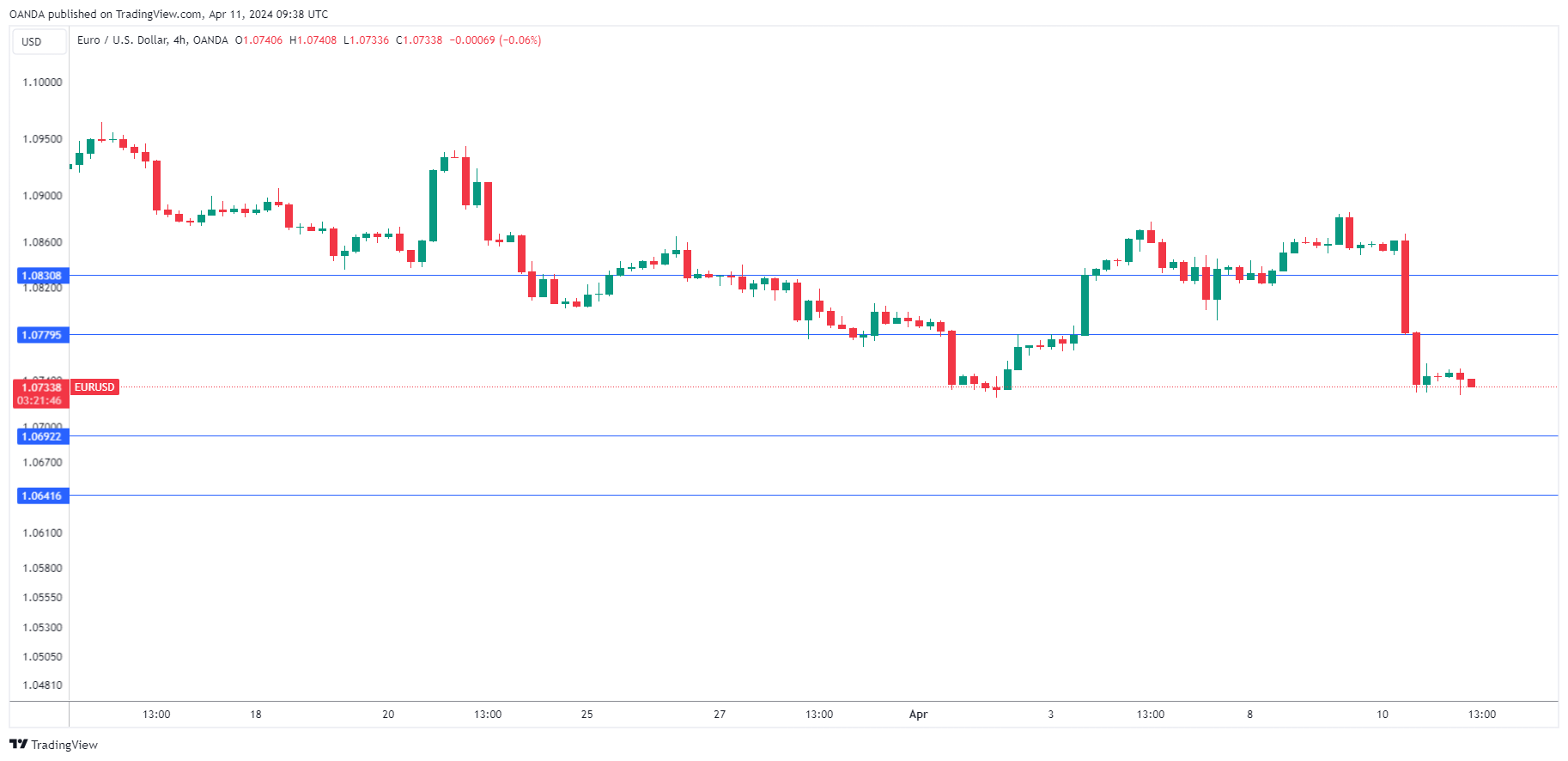
The euro is steady on Thursday, after sliding over 1% on Wednesday following the hot US inflation report. In the European session, EUR/USD is trading at 1.0745, down 0.03%.
ECB widely expected to hold rates
The European Central Bank meets later today and is widely expected to hold the deposit rate at 4% for a fifth straight time. Investors will be focusing on the rate statement, looking for signals of a rate cut in June. Some ECB policy makers have pointed to June cut and if ECB doesn' t follow suit could hurt the Bank' s credibility. The ECB would prefer to wait for the Fed to cut first, as this would boost the euro and push inflation lower. The most recent US nonfarm payrolls and inflation reports, however, were stronger than expected, which has lowered the probability of a Fed cut in June.
The eurozone economy is showing a bit more strength but a recession is still a possibility. Inflation fell to 2.4% in March, its lowest level since July 2021 and is closing in on the 2% target. Still, there is more work to do - core inflation is at 2.9% and services inflation remains very high at 4%.
The euro took a tumble on Wednesday, losing 1.05%, its worst daily performance since March 2023. The US dollar posted sharp gains against the majors, courtesy of a stronger-than-expected inflation report. In March, CPI jumped 3.5%, up from 3.2% in February and above the market estimate of 3.4%. Inflation has accelerated for a second straight month and has lowered expectations of a Fed rate cut to just 23% in June and 54% in July.
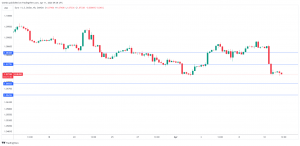
EUR/USD Technical
- There is support at 1.0692 and 1.0641
- 1.0779 and 1.0830 are the next resistance lines
|
Important - This article is for general information purposes only. It is not investment advice or a solution to buy or sell securities. Opinions are the authors - not necessarily OANDA' s, its officers or directors.
10-Apr-2024
  
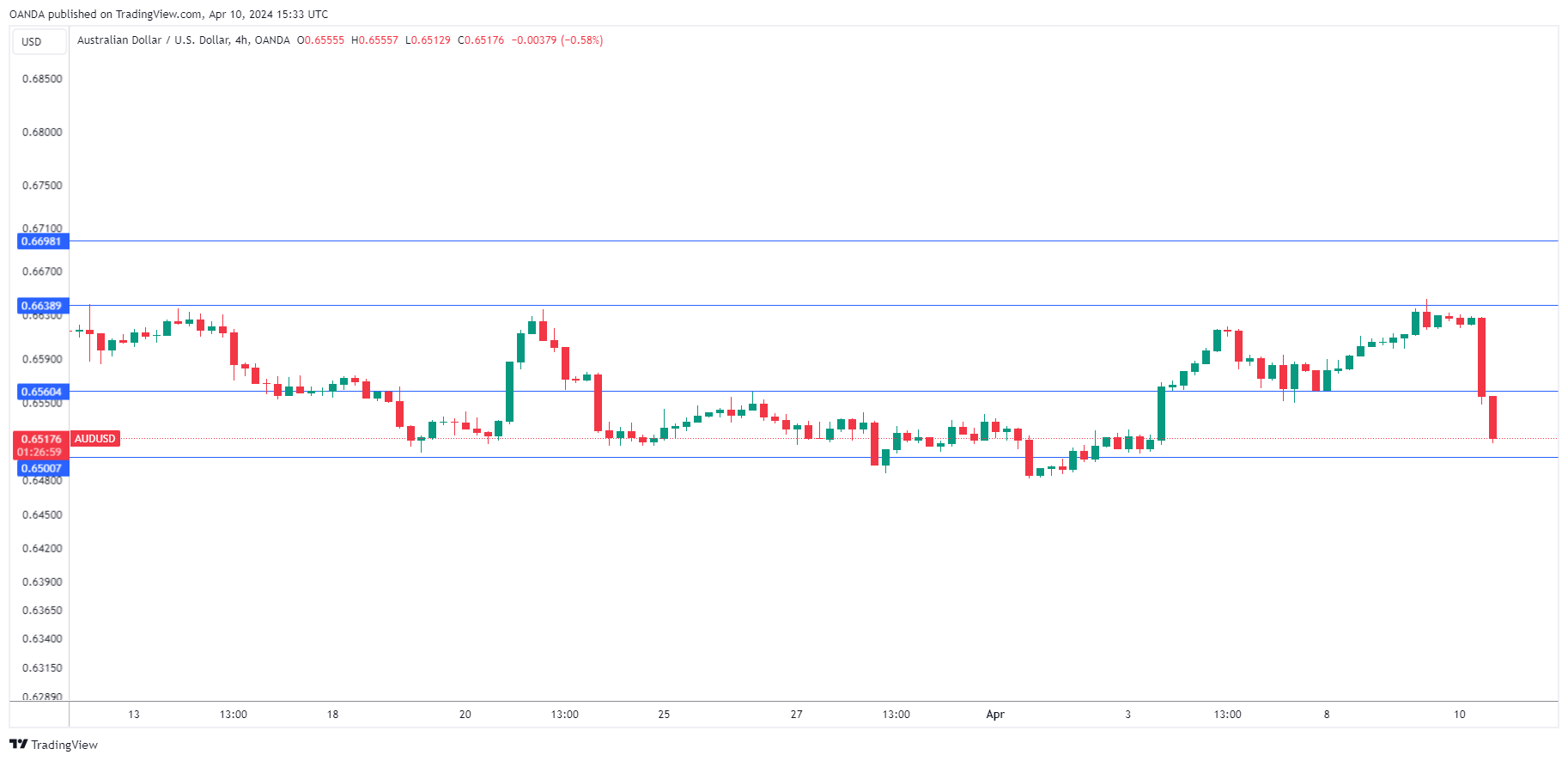
The Australian dollar has declined sharply on Wednesday. In the North American session, AUD/USD is trading at 0.6515, down 1.7%.
US inflation higher than expected at 3.5%
The US consumer price index has accelerated for a second straight month. The March CPI rose 3.5%, up from 3.2% in February and above the market estimate of 3.4%. This was the highest inflation rate since September. On a monthly basis, CPI remained unchanged in March at 0.4%, higher than the market estimate of 0.4%. The increase in inflation was mainly due to rising energy and shelter costs.
Core CPI, which is closely watched by the Federal Reserve, was unchanged at 3.8% in March and just above the market estimate of 3.7%. Monthly, core CPI rose 0.4%, matching the previous two months and above the market estimate of 0.3%. US inflation has accelerated for a second straight month, a reminder that although inflation appears under control, the final sprint to the 2% target will be a challenge for the Federal Reserve.
The strong inflation report has pushed back expectations on the timing of a first rate cut, propelling the US dollar higher against the major currencies and sending the Australian dollar reeling. The probability of a Fed rate cut in June has dropped from above 50% before the inflation report to 23% afterwards. Investors don' t consider a rate cut to be likely until September.
In Australia, consumer inflation expectations will be released Thursday. The forecast for April stands at 4.1%, down from 4.3% in March, which was the lowest level since October 2021. As well, China releases CPI, which is expected to decline by 0.5% in March, down from 1% in February. A reading below zero would point to deflation and weakness in China' s economy.
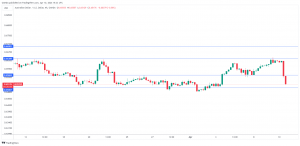
AUD/USD Technical
- AUD/USD is testing support at 0.6560 and is putting pressure on support at 0.6500
- 0.6638 and 0.6698 are the next resistance lines
|
Important - This article is for general information purposes only. It is not investment advice or a solution to buy or sell securities. Opinions are the authors - not necessarily OANDA' s, its officers or directors.MrBear12 ( Date: 10-Apr-2024 22:13) Posted:
|
https://www.google.com/amp/s/www.theedgesingapore.com/amp/news/singapore-economy/singapore-set-keep-monetary-policy-tight-may-ease-october
You can get up to 6% on 1-4 yrs FD for NZD.
The catch?
In one year you can lose up to 10% in FX.
Against SGD, NZD depreciates roughly 2 percent every year over the long term. very much like AUD vs SGD.
So if you invest down under, take this into consideration.
Invest with FX considerations
NZ Reserve Bank keeps Official Cash Rate unchanged at 5.5%
Photo credit: Getty
The NZ Reserve Bank has kept the Official Cash Rate at 5.5 percent.
Economists were predicting the OCR, which is updated seven times a year, would stay the same before Wednesday' s announcement.
Increasing the OCR increases interest rates and helps bring inflation down.
More to come.