 Post Reply
21-40 of 2876
Post Reply
21-40 of 2876
Small small so can hold ok
JAMMIE ( Date: 12-May-2026 10:55) Posted:
unfortunately no. there is no significant catalyst in the upcoming months. by the end of this FY , it will probably reach close to 3ish.
seanpent ( Date: 07-May-2026 16:57) Posted:
| Think may go back 2.90 in 1-2 weeks time |
|
|
|
unfortunately no. there is no significant catalyst in the upcoming months. by the end of this FY , it will probably reach close to 3ish.
seanpent ( Date: 07-May-2026 16:57) Posted:
| Think may go back 2.90 in 1-2 weeks time |
|
Add
seanpent ( Date: 07-May-2026 16:57) Posted:
| Think may go back 2.90 in 1-2 weeks time |
|
CapitaLand Investment, Singapore Retailers Association ink MOU to support S' pore retailers entering JB
https://sg.finance.yahoo.com/news/capitaland-investment-singapore-retailers-association-010000838.html
Think may go back 2.90 in 1-2 weeks time
CapitaLand Investment Limited &ndash Fee income drives growth
Recommendation: Buy (Maintained), Last Done: S$2.80
Target price: S$3.69, Analyst: Darren Chan
- 1Q26 revenue of S$487mn (-2% YoY) was slightly below our estimates, forming 21% of our FY26e forecast. Fee-related revenue was the standout performer, rising 10% YoY, driven by strong growth in listed (+14%) and private funds (+58%) management, while REIB revenue declined 14% following the divestment of the Synergy platform.
- Capital raising activity remained resilient despite a weaker macro backdrop amid the Middle East conflict, with S$2.5bn in equity raised across listed and private funds YTD, alongside S$7.2bn in deployment YTD.
- Maintain BUY with an unchanged SOTP-TP of S$3.69 and no changes to forecasts. The listing of a second C-REIT in the next couple of months should support continued capital recycling. We continue to favour CLI for its robust and growing recurring fee income and asset-light strategy, which underpins resilience amid macro uncertainty. However, we expect fundraising momentum and deployment to moderate from the strong 1Q26 levels in the coming months amid a more uncertain macroeconomic backdrop. While Singapore deals remain relatively more resilient given market stability, other markets are more cautious amid concerns around cost pressures and the potential impact of inflation on interest rates.
CapitaLand Investment posted S$487mn in Q1 revenue, up from S$444mn a year earlier, driven by a 10% rise in fee-related revenue to S$310mn, partly offset by a 14% decline in real estate investment business revenue to S$207mn following asset divestments.
Fee related income is growing nicely .....this counter might be going back to $3 series DYODD
CapitaLand Investment&rsquo s fee-related revenue up 10% y-o-y in 1QFY2026
CapitaLand Investment (CLI) recorded $310 million fee-related revenue, up 10% y-o-y, for 1QFY2026 ended March 31, supported by strong listed funds growth. This includes CLI&rsquo s 40% share of SC Capital Partners (SCCP) fee revenue.
As at March 31, 59% of CLI&rsquo s total revenue comes from its fee business, while 41% comes from its investment business.
CLI&rsquo s private funds segment grew the most across segments, surging 58% y-o-y to $41 million in 1QFY2026. This includes CLI&rsquo s 40% share of SCCP fee revenue, amounting to some $2 million and $7 million for listed and private funds management respectively.
Listed funds management grew 14% y-o-y to $87 million in 1QFY2026, while commercial management grew 3% y-o-y to $98 million for the quarter. Lodging management, meanwhile, was stable y-o-y, at $84 million in 1QFY2026.
CLI&rsquo s all-in fee-related revenue over funds under management (FRR/FUM) was 82 basis points (bps) during the quarter, down slightly from 85 bps over FY2025.
CLI&rsquo s fund management fee-related revenue to funds under management ratio (FM FRR/FUM) was 51 bps during the quarter, down slightly from 52 bps over FY2025.
CLI&rsquo s balance sheet, based on open market value, fell $0.4 billion y-o-y to $3.9 billion in 1QFY2026, as CLI works on improving capital efficiency.
CLI&rsquo s net debt/equity stands at 0.41 times as at 1QFY2026, down from 0.43 times in FY2025. CLI&rsquo s interest coverage ratio fell to 3.9 times in 1QFY2026 from 4.2 times in FY2025.
CLI&rsquo s fixed rate debt stands at 73% as at 1QFY2026, compared to 72% in FY2025.
CLIs&rsquo average debt maturity stands at 2.9 years in 1QFY2026, down from 3.1 years in FY2025, with implied interest cost at 3.6% per annum in 1QFY2026, down from 3.9% per annum in FY2025.
CLI&rsquo s operating cashflow, which includes dividend received from associates, joint ventures and other investments, stands at $289 million in 1QFY2026, up from $255 million in 1QFYF2025.
In its business update released April 29, CLI says uncertain market conditions are expected to moderate the pace of capital raising and deployment, with continued focus on risk-adjusted returns.
&ldquo Potential inflation-driven cost pressures may weigh on asset operations, reinforcing ongoing portfolio optimisation and cost discipline,&rdquo adds CLI.
CLI says a continued focus on its high-conviction themes &mdash lodging and living, logistics and self-storage, real estate credit &mdash in resilient markets like Singapore, Japan and Australia continue to attract institutional capital and provide stability.
&ldquo CLI&rsquo s strong balance sheet and capital position provide flexibility to pursue strategic and accretive opportunities,&rdquo it adds.
Shares in CLI closed 0.71% down at $2.81 on April 28, up 2.5% year to date.
CapitaLand Investment sets sights on single flagship C-Reit to drive scale
It intends to combine CapitaLand Commercial C-Reit with a second China Reit slated to list this year
[SINGAPORE] CapitaLand Investment : 9CI -0.35% (CLI) aims to eventually combine its two China real estate investment trusts, or C-Reits, into a single flagship vehicle as it builds scale.
The global asset manager listed its first internationally sponsored retail C-Reit, CapitaLand Commercial C-Reit, in September 2025, seeded by CapitaMall SKY+ and CapitaMall Yuhuating.
It plans to list a second commercial C-Reit in the second or third quarter of 2026, said Puah Tze Shyang, chief executive officer of CLI China, at the group&rsquo s annual general meeting (AGM) on Tuesday (Apr 28).
The second C-Reit will be seeded by two assets: Raffles City Shenzhen, a mixed-use development comprising retail, office and serviced residence components and CapitaMall Fucheng, a retail mall in Sichuan province.
&ldquo If we are able to combine the two... subject to regulators&rsquo guidance and support, we could have bigger scale and greater diversity across asset classes, and I think these are the factors that will lead to a more robust-performing C-Reit,&rdquo said Puah.
&ldquo The intention is to have a single flagship C-Reit that will allow us to recycle capital on some of our stabilised China assets.&rdquo
For the 2025 financial year, CLI&rsquo s earnings were S$145 million, down 70 per cent from S$479 million in FY2024, due mainly to lower portfolio gains and higher revaluation losses on the group&rsquo s China portfolio.
Significant non-cash revaluation losses within its China portfolio pushed CLI&rsquo s full-year overall revaluation loss in FY2025 to S$439 million, widening from FY2024&rsquo s S$261 million.
CLI generated a return on equity (ROE) of 1.1 per cent in 2025. However, excluding China, ROE would have been about 6.9 per cent, improving from 6.7 per cent and indicating steady underlying progress, noted the group.
Portfolio optimisation efforts in China &ldquo remain a strategic priority&rdquo for CLI, it said in a bourse filing on Apr 23, responding to shareholders&rsquo questions ahead of the AGM.
It added that its &ldquo domestic-for-domestic approach provides multiple pathways to progress divestments&rdquo , including C-Reits, renminbi-denominated fund structures and selective third-party asset sales, which allow the company to recycle capital while building fee-earning funds under management.
While China&rsquo s economy is recovering gradually, with gross domestic product reaching 5 per cent in Q1 2026, the recovery has been uneven across sectors, said Puah, noting that CLI&rsquo s greatest exposure is to commercial real estate.
Lee Chee Koon, the group&rsquo s CEO, said at the AGM: &ldquo There has been an oversupply of commercial real estate in various Chinese cities, and the challenge is more pronounced in the office and business parks segments.&rdquo
He added: &ldquo A lot of foreign companies are not expanding in China, and locally, some of the Chinese companies are taking a wait-and-see approach. However, retail, hotels and rental apartments are doing relatively well, and we are starting to see green shoots of recovery.&rdquo
CLI does not expect recent geopolitical developments to have a material direct impact on its China divestment plans, but prolonged tensions could affect global risk sentiment &ndash which may indirectly influence transaction activity and pricing, the group said in its Apr 23 filing.
Merger with Mapletree may not be a good fit, some shareholders tell CapitaLand Investment
SINGAPORE - CapitaLand Investment (CLI) responded at length to a shareholder&rsquo s question on a rumoured acquisition of Mapletree Investments, reiterating that it would not pursue deals simply to meet its $200 billion funds under management (FUM) target by 2028.
At its annual general meeting on April 28, the real asset manager said any merger and acquisition (M& A) would have to deliver clear benefits to shareholders.
More than 800 shareholders attended the meeting at the Sands Expo and Convention Centre.
The Wall Street Journal first reported on Nov 3, 2025, that the two asset managers were exploring a merger. Since then, neither has confirmed the talks nor provided any updates.
But group chief executive Lee Chee Koon had told the media at CLI&rsquo s financial year 2025 results briefing on Feb 11 that the company was assessing numerous possible deals on their affordability and ability to be integrated into CLI.
The shareholder who posed the question noted that Mapletree, which has $80.3 billion in assets under management as at March 31, 2025, may not be the right fit for CLI.
He added that while the real estate investment firm has expanded into data centres and purpose-built student accommodation, these segments have also seen impairments, where losses are booked when assets are worth less than expected.
The shareholder said Mapletree&rsquo s asset strategy appears to be &ldquo vertically siloed&rdquo , with its two real estate investment trusts (REITS) &ndash Mapletree Investment Trust and Mapletree Logistics Trust &ndash focusing on industrial and logistics assets.
A merger of these assets could run counter to CLI&rsquo s risk diversification strategy through CapitaLand Ascendas REIT, its biggest industrial REIT.
&ldquo I hope we don&rsquo t do things just to grow the FUM,&rdquo the shareholder said. &ldquo This is something that really troubles a lot of us.&rdquo
Analysts had previously rated a potential merger as a positive move for CLI to expand its scale, allowing the merged entity to compete against global giants in real estate and asset management such as Blackstone and Brookfield.
In response, CLI&rsquo s chairman Miguel Ko reassured shareholders that CLI has not wavered from its commitment to pursuing meaningful M& As. &ldquo We are here to ensure that all of you in this room are well protected.&rdquo
Independent director Anthony Lim said that in any deal that it seeks to complete, the board would not only have to address the views of its minority shareholders but those of its majority shareholder, Temasek, too.
CLI would assess the reasons for acquiring any company, and weigh its worth against its price, as well as the payment structure.
Mr Lee added that there is no perfect deal, and CLI would assess how it can address any shortcomings in a company it acquires.
China concerns
Mounting pressures in China&rsquo s real estate market were also a key concern for CLI&rsquo s shareholders.
They raised questions about the real asset manager&rsquo s strategy in China and how it plans to monetise its assets, as plunging valuations drove its profit down from $479 million to $145 million for the 2025 financial year.
Mr Puah Tze Shyang, chief executive of CLI China, said that the company has the greatest exposure to commercial real estate, and rents in the country have been declining over the last three to four years as a result of a slowdown in the Chinese economy and domestic consumption. It is hoping for a stabilisation in the property market and a recovery in consumption sentiment, before rents begin to improve.
Mr Lee added that weaker performance at CLI&rsquo s business parks in China was partly due to an oversupply of commercial space in several cities, as well as fewer foreign firms expanding there and local companies adopting a &ldquo wait-and-see&rdquo approach.
But it is beginning to see green shoots of recovery, particularly in the retail sector, which has shown the most resilience. The hotel and rental apartment sectors are also expected to recover more quickly, although business parks and offices would take longer, he said.
Double-digit ROE
A representative of non-profit research house Corporate Monitor asked the board how it intends to improve the company&rsquo s return on equity (ROE), which has been below 5 per cent over the last six years.
ROE measures how well a company uses shareholders&rsquo money to generate profit.
Chief financial officer Paul Tham acknowledged that the China business had &ldquo dragged down&rdquo the company overall. Its ROE, averaging around 4 per cent over the last two years, would have gone up to 6.7 per cent in financial year 2024 and 6.9 per cent in financial year 2025 if not for the Chinese market downturn.
He noted that a double-digit ROE figure remains the target. As fee income-related businesses continue to grow and the company continues to divest assets, it should hit an ROE of 8 per cent to 9 per cent &ndash excluding the China business &ndash in the coming years.
Despite ongoing challenges in the China market, CLI is preparing to launch its second China REIT (C-REIT), first announced on Feb 11, in the late second quarter or early third quarter of 2026.
The asset manager successfully listed its first C-REIT, known as CapitaLand Commercial C-REIT, on the Shanghai Stock Exchange on Sept 29, 2025.
It is now aiming to combine both C-REITs into a &ldquo single flagship C-REIT that combines scale&rdquo , subject to regulators&rsquo guidance and support, said Mr Puah.
This would not only allow CLI China to recapitalise some of its stabilised China assets, but also afford it greater scale and diversity of asset classes, which are factors that lead to a &ldquo more robust performing C-REIT&rdquo .
CapitaLand Investment to manage Income Insurance&rsquo s S$2.4 billion real estate investment portfolio
Including the new mandate, CLI has completed &lsquo over S$12.1 billion&rsquo in Singapore deals in the past 16 months
[SINGAPORE] CapitaLand Investment ( CLI : 9CI -1.72%) has won a S$2.4 billion real estate investment mandate from Income Insurance.
Under the mandate, CLI will manage Income Insurance&rsquo s direct real estate portfolio, comprising retail, commercial and industrial assets held directly by the insurer and through its joint ventures.
CLI said that it would use its portfolio-management capabilities to &ldquo enhance the performance of Income Insurance&rsquo s existing real estate assets in Singapore... while actively seeking and evaluating new investment opportunities for Income Insurance across the Asia-Pacific region&rdquo .
Including the new investment mandate, CLI has completed &ldquo over S$12.1 billion&rdquo in Singapore deals in the past 16 months.
It added that it &ldquo continues to invest in its home market, Singapore, as it pursues capital recycling across multiple asset classes to drive higher returns for investors&rdquo .
This includes the recent divestment of Asia Square Tower 2 for S$2.5 billion by CapitaLand Integrated Commercial Trust : C38U -0.4%, and the acquisition of Paragon for S$3.9 billion.
It also includes the joint acquisition of business space property Ascent by CapitaLand Ascendas Reit : A17U -0.39% and a global sovereign wealth fund, for a total consideration of S$490 million.
CLI said that, beyond driving fee-related revenue, these transactions also &ldquo demonstrate CLI&rsquo s scale, network and proven ability to connect leading global institutional investors with high-quality investment opportunities in Singapore&rdquo .
Shares of CLI fell 1.7 per cent or S$0.05 to close at S$2.85 on Thursday, before the news.
CapitaLand Investment wins S$2.4 billion real estate investment mandate from Income Insurance
Over S$12.1 billion in Singapore deal-making in the past 16 months reinforces CLI&rsquo s position as the asset manager of choice
https://links.sgx.com/1.0.0/corporate-announcements/YS5ANKGFR639WHAW/885406_News%20Release%20-%20CapitaLand%20Investment%20wins%20S%242.4%20billion%20real%20estate%20investment%20mandate%20from%20Income%20Insurance.pdf
Thank you for the caution, 7Ocean
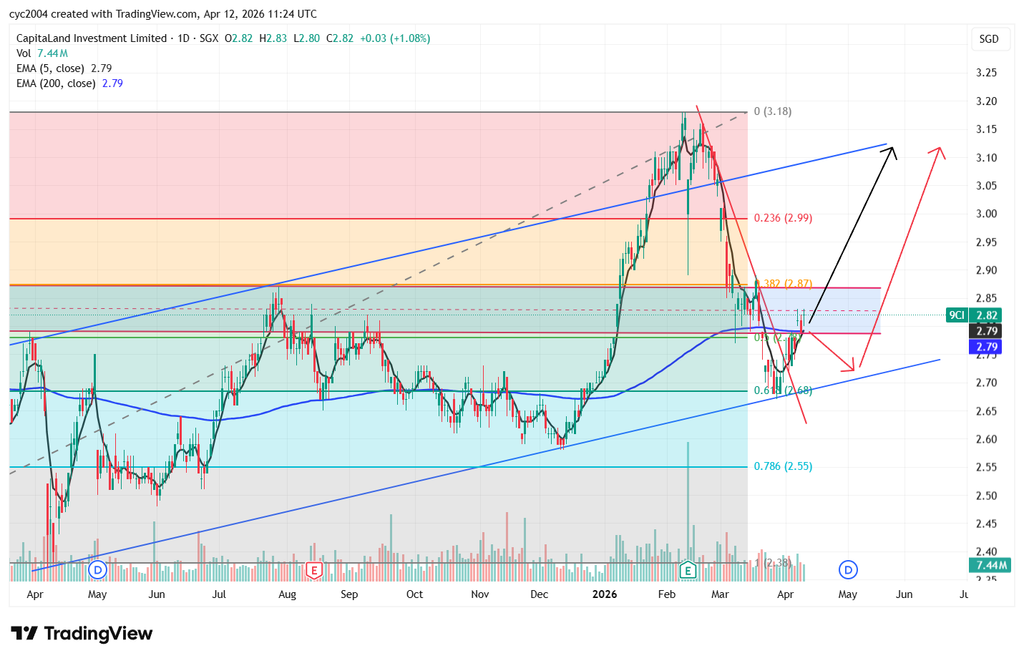
5EMA = 20EMA = 200EMA = 2.79 (very very rare to see these 3 MAs align together)
Fri' s share price of 2.82 closed above the long term 200EMA (2.79). Let' s see how price react at that level tomrrow.
7ocean ( Date: 12-Apr-2026 15:00) Posted:
Negotiations between Iran n the USA have broken down, The erratic US president may unleash a barrage of attacks on Iran in the next day or two, It' s best to hold off 2moro morning.
JurongW ( Date: 12-Apr-2026 13:06) Posted:
| CLI should continue its upward momentum this week. |
|
|
|
His EGO cannot take losses... Lose face..
MrBear12 ( Date: 12-Apr-2026 15:02) Posted:
I think he is tired of war, just as we are.
7ocean ( Date: 12-Apr-2026 15:00) Posted:
| Negotiations between Iran n the USA have broken down, The erratic US president may unleash a barrage of attacks on Iran in the next day or two, It' s best to hold off 2moro morning |
|
|
|
I think he is tired of war, just as we are.
7ocean ( Date: 12-Apr-2026 15:00) Posted:
Negotiations between Iran n the USA have broken down, The erratic US president may unleash a barrage of attacks on Iran in the next day or two, It' s best to hold off 2moro morning.
JurongW ( Date: 12-Apr-2026 13:06) Posted:
| CLI should continue its upward momentum this week. |
|
|
|
Negotiations between Iran n the USA have broken down, The erratic US president may unleash a barrage of attacks on Iran in the next day or two, It' s best to hold off 2moro morning.
JurongW ( Date: 12-Apr-2026 13:06) Posted:
| CLI should continue its upward momentum this week. |
|
CLI should continue its upward momentum this week.
AI &lsquo redistributing demand&rsquo for offices, business parks in S&rsquo pore, China and India: CapitaLand Investment
Artificial intelligence (AI) is redistributing jobs, not eliminating them, says CapitaLand Investment (CLI). This is set to change how tenants occupy offices and business parks in Singapore, India and China &mdash assets that are found in the portfolios of CLI&rsquo s stable of Singapore-listed REITs, particularly CapitaLand Integrated Commercial Trust (CICT), CapitaLand Ascendas REIT (CLAR), CapitaLand India Trust (CLINT) and CapitaLand China Trust (CLCT).
Based on CLI&rsquo s engagement with occupiers across the three markets, the emerging pattern is &ldquo not a broad-based contraction, but a redistribution of demand&rdquo .
According to CLI&rsquo s six-page research report titled Tracking AI&rsquo s impact on offices and business parks in Apac, AI is &ldquo unlikely to reduce the relevance of physical workspace across Apac any more than Covid-19 did, but it will reshape its purpose and value&rdquo .
&ldquo Demand will become more selective, concentrating in locations and assets that can support innovation, coordination and still-nascent but increasingly complex human-AI workflows,&rdquo say authors Tran Hanh Link and Wayne Teo from CLI.
At the same time, space that is unable to adapt to these requirements will face growing structural headwinds, reads CLI&rsquo s report, released April 9. This is accelerating a &ldquo K-shaped divergence&rdquo where &ldquo high-specification, well-located and infrastructure-ready assets will remain integral to business operations, while commoditised space will face structural pressure&rdquo .
Across the Asia-Pacific region (Apac), office employment is projected to grow steadily by 3.5% in 2026, according to CBRE&rsquo s 2026 Apac real estate outlook. However, office occupiers&rsquo expansion plans vary significantly by country and sector.
The technology sector (which includes AI) recorded the highest proportion of occupiers planning to expand, led by China, Singapore and India. In contrast, fewer than half of tenants in other sectors indicated intentions to expand, notes CLI.
S&rsquo pore as an Apac HQ
Growing AI adoption is shaping office demand in Singapore, with both traditional sectors and AI-native occupiers seeking &ldquo premium, strategically located Apac headquarters (HQ)&rdquo , says CLI.
Greater use of AI workflows, analytics and digital tools is driving tenants to prioritise &ldquo high-quality, well-located and amenity-rich offices&rdquo , reinforcing the ongoing flight-to-quality trend, adds CLI. &ldquo Demand is coming not only from AI-native firms but also from traditional sectors like financial institutions, legal and professional services, which are increasingly integrating AI into their operations.&rdquo
According to CLI, some of the largest AI players in the quantitative finance sector operate at CapitaSpring and Raffles City Tower, with one firm demonstrating &ldquo cross-market synergies&rdquo in Singapore and Shanghai.
But stronger demand for prime Central Business District (CBD) office space in Singapore is meeting a supply crunch that is set to last for the next two years. Only 0.35 million sq ft of new space is expected by 2028, underpinning projected rental growth of around 4.4% per annum between 2026 and 2028.
CLI says past declines in Singapore business park occupancies due to hybrid work and back-office offshoring have &ldquo stabilised&rdquo . Instead, tenants are now exploring expansion after experiencing the effects of &ldquo over-consolidation&rdquo , claims CLI.
&ldquo Despite caution on long-term commitments, AI has not led to reduced space requirements or downsizing,&rdquo adds CLI. &ldquo Business parks with technology, biomedical and research tenants remain resilient, supported by nearby research institutions, hospitals and the growing AI ecosystem.&rdquo
Kampong AI, the integrated start-up community at one-north announced during Budget 2026, is expected to anchor approximately 70 additional AI firms in the area. In addition, CLAR&rsquo s upcoming 11-storey 27 International Business Park near the Jurong Lake District, &ldquo will further strengthen demand for high-quality space&rdquo , says CLI.
India&rsquo s large AI workforce
India&rsquo s large and young AI-ready workforce is translating directly into rising occupier demand, as global corporations increasingly channel AI-related investments into the country, says CLI.
India&rsquo s AI workforce is projected to comprise some 1.25 million professionals by 2027, with the AI market there projected to grow at 25% to 35% through 2027, according to Deloitte.
India also leads in AI hiring growth and accounts for 20% of all AI projects globally on GitHub, ranking second, according to the Stanford Institute for Human-Centered Artificial Intelligence.
Global Capability Centres (GCCs) are the largest driver of Grade-A office demand in India. These offshore entities established by multinational corporations (MNCs) are expected to account for 35% to 40% of total office leasing demand in 2026, consistent with the historical average of 38% between 2020 and 2025, according to CBRE.
New growth is anticipated from mid-market companies, global unicorns and emerging sectors. Bengaluru, Hyderabad and Delhi are the top three metros for GCC expansion together they accounted for 69% of total GCC absorption in 2025, according to CBRE.
CLI says tenants there are focusing on integrated technology parks and campus-style environments to accommodate larger, more complex and innovation-led teams. &ldquo For example, a global software development services provider serving leading technology firms such as Google, AWS and SAP leased over 125,000 sq ft in the last few years at International Tech Park Hyderabad, with further expansion planned in 2026.&rdquo
In 2026 and 2027, around 45% of new office supply in India is expected to be Grade-A, with around 65%-68% located within integrated technology parks, up from 54%-58% in 2024 and 2025, says CBRE.
China impacted by supply glut, headwinds
China&rsquo s AI development is perhaps most recognised through DeepSeek, which launched a generative AI chatbot in January 2025 that rivalled models from the West, reportedly at a cost of just US$5.6 million.
AI is emerging as a meaningful source of new leasing demand for both China&rsquo s offices and business parks, says CLI, but there also has been some space consolidation due to AI-driven optimisation.
Still, broader macroeconomic headwinds remain the main drag, adds CLI. In 2025, nationwide average office rents declined 10.4% y-o-y, the second-largest annual decline since 2008, while vacancy rose 1.3% y-o-y to 24.7%, reflecting supply additions (4.43 million sqm) that continue to outpace demand (2.15 million sqm).
CLI believes there are early signs that demand is stabilising. Full-year net absorption surpassed 2 million sqm for the first time in three years, while expansionary momentum from the technology, media and telecommunications sector drove Beijing' s vacancy to its lowest level in three years.
Leasing demand is becoming more concentrated in specific submarkets and asset types aligned with AI development, even as broader market conditions remain challenging, says CLI. &ldquo This suggests AI is becoming a more measurable demand at the submarket level, but remains insufficient to absorb the broader supply overhang.&rdquo

