

 Post Reply
21-40 of 144
Post Reply
21-40 of 144
After uncles and aunties finished selling, can come in to load up some again?
Life is tough with high cost of living, profit taking and solve some problems first
dexterderc ( Date: 10-Apr-2026 16:54) Posted:
|
I didn't know auntie uncle so powerful. I wonder have the aunties and uncles finish selling. 😂
easywin ( Date: 10-Apr-2026 15:40) Posted:
|
Trust your own judgement. We are just here to give inputs.
7ocean ( Date: 10-Apr-2026 15:16) Posted:
|
CPF buy at $2 now good profit still wanna to wait?
Really because of auntie uncle selling?
7ocean ( Date: 10-Apr-2026 14:43) Posted:
|
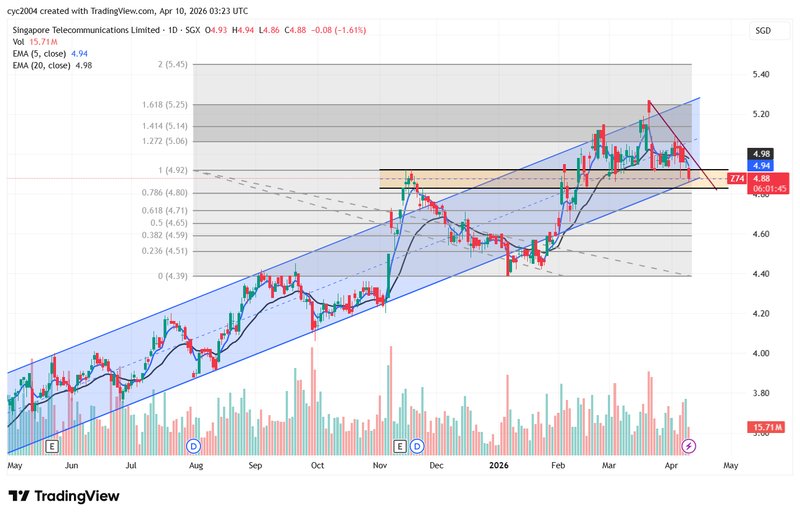
Its will 1 month to retracement
JurongW ( Date: 10-Apr-2026 15:05) Posted:
|
Trade what you see on the chart. It will eventually move up after the retracement is completed.
7ocean ( Date: 10-Apr-2026 14:43) Posted:
|
Singtel buying back from uncles and aunties.
7ocean ( Date: 10-Apr-2026 14:43) Posted:
|
Uncle and Auntie kept on selling CPF Singtel share, will Uncle and Auntie drag down the singtel' s shares???????...
JurongW ( Date: 09-Apr-2026 18:19) Posted:
|
SBB today - 1,700,000 shars bought at 4.93 to 4.96 ($8,424,075)
What does the transfer of Singtel discounted shares mean for investors should they sell or hold?
BT looks into what analysts have to say on its market impact, and how investors may respond
[SINGAPORE] Singtel and the Central Provident Fund (CPF) Board have launched an exercise to migrate all Singtel Special Discounted Shares (SDS) from the board&rsquo s custody directly into investors&rsquo personal Central Depository (CDP) accounts.
The details of the exercise were announced after the first reading of the CPF (Amendment) Bill in Parliament on Tuesday (Apr 7).
The transfer is set to give 615,000 retail investors unfettered control over their holdings &ndash including immediate access to cash proceeds if they choose to sell.
The Business Times looks into the legacy scheme, what analysts have to say on the transfer&rsquo s market impact, and what investors should do.
What is this scheme and how does the change work?
Unlike other Singtel ordinary shares, the SDS are currently held in trust by the CPF Board on behalf of investors.
The SDS scheme is a legacy scheme that dates back to Singtel&rsquo s 1993 initial public offering. Launched as a national asset enhancement initiative, it aimed to give Singaporeans a direct stake in the country&rsquo s economic success.
The government embedded a loyalty programme into the scheme to discourage investors from immediately flipping discounted shares for profit &ndash investors who kept their stock would receive free loyalty shares over time.
Starting Wednesday, shareholders who divest their SDS holdings can withdraw the proceeds in cash directly to their registered bank accounts. These cash payouts are expected to be processed within 14 business days.
Further, a retroactive concession will be granted for those who sold their SDS between Jan 1, 2025, and Apr 7, 2026. These investors can apply to have those past proceeds &ndash currently sitting in their CPF accounts &ndash released to them in cash.
For those who prefer to remain invested in the telco, no action is needed. Unless shareholders choose to sell early, their SDS will be automatically migrated to their personal CDP accounts on Nov 21, 2026.
Read more on the change: Singtel, CPF Board to transfer legacy discounted shares to investors&rsquo CDP accounts, giving 615,000 shareholders direct control
How will it affect Singtel shares, and should investors sell?
The youngest SDS holders are in their early 50s today, with the median shareholder owning around 1,360 Singtel SDS, inclusive of original purchases alongside accumulated loyalty shares.
An investor would reap a return of around six times on their original investment, as a rough gauge. As at Apr 1, 2026, that median shareholding is worth around S$6,800 &ndash a sizeable increase from the original outlay of around S$2,000 that SDS holders would have spent initially.
Moreover, these shareholders have received some S$5,000 in cumulative dividends to their CPF accounts.
The transfer &ndash which effectively removes the administrative friction of selling these shares &ndash has raised questions about whether it may introduce excess liquidity into the market, if all SDS holders chose to sell.
Analysts BT spoke to generally think it is unlikely that all SDS holders will immediately liquidate their positions in November, when the mass transfer of shares takes place.
For one thing, SDS holders have kept the shares for around 30 years and &ldquo enjoyed good returns from (the) investment&rdquo , said Carmen Lee, OCBC head of equity research.
&ldquo Unless there are other compelling alternative investments or personal reasons to exit, most investors are unlikely to sell immediately in November,&rdquo she said.
Moreover, the stock still provides a dividend yield that is estimated to be 3.7 per cent, &ldquo which is decent for long-term yield seeking investors&rdquo . She attributed this to the outperformance of Singtel shares, which are up by around 9 per cent year to date and have hit a recent high of S$5.27.
Since SDS holders already had the option to sell their shares under the previous scheme, albeit through a more indirect process, Maybank Securities analyst Hussaini Saifee does not see the exercise as a completely new source of liquidity.
He acknowledges that an excess liquidity event could occur in the event that SDS holders sell all their Singtel holdings at once &ndash which would increase free float and trading liquidity &ldquo to some extent&rdquo &ndash but believes this is unlikely.
He therefore does not foresee the exercise directly affecting Singtel shareholders in general.
Noting that Maybank Securities maintains a &ldquo buy&rdquo rating on Singtel, the analyst said that the decision to buy or sell should depend on investors&rsquo individual outlook on the stock.
Analysts also pointed out that trading of SDS shares accounted for less than 0.5 per cent of Singtel&rsquo s average daily trading volume over the last two years.
&ldquo (This) should eliminate concerns of a potential share overhang from a sell-down (in the event of) SDS holders exiting,&rdquo said an RHB analyst.
He noted that the bank has made no changes to its &ldquo buy&rdquo rating and S$5.50 target price for Singtel.
Citing management&rsquo s positive views, the analyst further highlighted that the exercise may remove &ldquo cumbersome SDS administrative procedures&rdquo . These include having to inform the CPF Board of impending corporate actions before the information is relayed by the board to SDS shareholders, he said.
&ldquo The exercise would allow fresh corporate actions such as dividend-in-specie distributions to directly benefit SDS shareholders going forward,&rdquo he added.
Singtel could be the real winner as mom-and-pop investors land surprise S$6,800 windfall
For the group, the real prize is unlocking its own corporate toolkit
[SINGAPORE] The narrative being spun around Singtel&rsquo s massive Special Discounted Shares (SDS) transfer is heavy on the warm, fuzzy angles.
It is a story about giving the Pioneer and Merdeka generations a sudden cash windfall. It is about freeing up legacy wealth and empowering the retail investor.
It is, admittedly, a great story.
For the median shareholder holding 1,360 SDS from the 1993 initial public offering, this policy change is a sudden, fully liquid S$6,800 bonus.
More than half a million older Singaporeans can finally sell their stock and take the cash straight to the bank, completely bypassing the usual Central Provident Fund (CPF) lock-ups.
But let us be brutally honest. A multinational company does not initiate a multi-year, multi-agency legal restructuring just to help you fund a holiday to Okinawa.
Behind the public relations glow, this exercise is a massive, necessary corporate untangling. Be under no illusion: Singtel is doing this for Singtel &ndash but there&rsquo s nothing wrong with that.
To understand why, you have to look at how absurd the current set-up is.
Singtel has more than 700,000 retail shareholders. But for 615,000 of them, the company is not legally allowed to speak to them directly. Because these shares were bought using CPF funds under a special 1993 scheme &ndash back when most people did not have trading accounts &ndash the CPF Board acts as the legal trustee.
If Singtel wants to send an annual report, invite them to an annual general meeting or pay a dividend, it has to route everything through a government statutory board. It is a costly, clunky, two-step bureaucratic dance that belongs in the 1990s, not 2026.
Today, if an elderly SDS holder wants to sell, they could do it online. The non-digital natives among them &ndash and there are many &ndash will likely have to walk down to a SingPost branch and fill out physical forms. Those forms are batched, sent to a broker and processed manually over several days.
In an era where teenagers trade stocks on their phones in seconds, these retail investors are selling blind, entirely unable to lock in a live market price.
Moving the shares to direct Central Depository (CDP) accounts drags these investors into the modern trading era. But for Singtel, the real prize is unlocking its own corporate toolkit.
Unlocking more than cash
When you have 615,000 shareholders locked behind a trust scheme, your hands are tied when it comes to financial engineering.
If a normal company wants to preserve cash, it might issue a scrip dividend, paying investors in new shares instead of cash. If it wants to raise capital or reward shareholders, it might execute a rights issue or a bonus share issue.
Under the legacy CPF scheme, doing any of this is logistically maddening. By dumping these shares directly into individual CDP accounts, Singtel can finally pull the same levers as any other listed company without the system melting down.
A cleaner capitalisation table &ndash a document that lists all shareholders and the number of shares they own, as well as the type of securities &ndash makes future corporate actions far smoother.
This clean-up is not happening in a vacuum. Singtel is actively trying to shake off its reputation as a sleepy, stable local utility. It is chasing double-digit returns and expanding heavily across South-east Asia. It is aggressively building out capital-hungry data centres alongside private-equity heavyweights such as KKR.
And when you are trying to execute complex strategic moves or potentially restructure parts of your business, the last thing you want is a messy, legacy capital structure holding you back.
Finally, there is the matter of market liquidity. Right now, about 4.4 per cent of Singtel&rsquo s total shares are essentially in a coma. They sit in CPF accounts, largely forgotten, generating dividends but doing absolutely nothing for the stock&rsquo s daily trading volume.
By putting these shares directly into the hands of retail investors and waiving the withdrawal rules, Singtel is injecting life back into this dormant float.
Whether people hold them in their active CDP accounts or sell them on the open market, it creates more liquidity. Better liquidity is generally good for a stock&rsquo s overall health and pricing.
None of this is to say that retail investors are getting a bad deal. Giving people direct control over their assets and letting them keep the cash is a clear win for the public. It finally closes the loop on the grand social experiment of 1993.
But as investors, we should always look at the incentives. The public might be getting a nice cash payout, but make no mistake: Singtel is the one getting its house in order.
They are finally shedding a 30-year-old statutory board legacy so they can actually run like a modern, agile company.
SBB today - 5,207,300 shares bought at 4.96 to 4.99 ($25,948,271)
IMDA reviewing resilience regulations in wake of Singtel disruptions
No evidence of cyberattacks but the authority does not rule out that 3 outage incidents at the telco were related in some way
[SINGAPORE] The Infocomm Media Development Authority (IMDA) is currently reviewing the telcos service resilience regulations following the various network failures by Singtel in March, said the Minister for Digital Development and Information Josephine Teo.
Teo noted that the Singapore government &ldquo will not hesitate to take strong regulatory action&rdquo should any lapses be found following the investigation.
&ldquo Thus far, there is no evidence that the incidents were due to cyberattacks,&rdquo Teo said in response to parliamentary queries on Tuesday (Apr 7). However, she noted that the IMDA does not rule out that the three incidents were &ldquo related in some way&rdquo .
Teo said that under current regulations, it is mandatory for stress testing and simulation of failover systems under peak or adverse conditions to take place.
That said, the investigation might uncover parts of the system where the stress testing might have been overlooked, she noted.
&ldquo (The findings of the investigation) will then inform our understanding of the extent to which we need to then strengthen the regulations and put in place the right set of obligations and expectations,&rdquo she said.
Compensation for affected customers
The recent Singtel compensation to customers &ndash following a string of service disruption &ndash is out of the telco operator&rsquo s &ldquo own volition&rdquo , driven by market competition, said Teo, noting that across the world, no country requires telco providers to compensate users following a service disruption.
In March, Singtel had three network failures that impacted hundreds of thousands of users. Most notably, a nine-hour outage on Mar 16 left approximately 600,000 users without mobile service.
Singtel on Mar 31 announced that it will give affected users a &ldquo goodwill rebate&rdquo , which can be used to offset the customer&rsquo s bill within the next one to two billing cycles.
Users impacted by the disruption reported receiving a sum of S$5 or S$10, depending on their mobile plans.
Teo noted that even though the United Kingdom and Germany do require compensation for service disruptions, the scope of the compensation only covers the loss of service for broadband and landline.
Based on this definition, Singtel users would not qualify for compensation, she said.
Instead, she noted, Singapore relies on the highly competitive nature of the telco market to maintain consumer goodwill and prevent customer churn.
In the case of Singtel, the company decided that the extent of its disruption was large, and the company would offer a one-time rebate as part of their service recovery, she added.
&ldquo This was done on Singtel&rsquo s own volition,&rdquo Teo said.
Singtel, CPF Board to transfer legacy discounted shares to CDP, easing way for 615,000 investors to unlock cash
As a rough gauge, an investor will make a return of about six times on the original investment
[SINGAPORE] Singtel : Z74 -0.8% and the Central Provident Fund (CPF) Board have initiated an exercise to transfer all Special Discounted Shares (SDS) currently held in trust by the CPF Board directly into investors&rsquo individual Central Depository (CDP) accounts.
The move will unwind a 30-year-old legacy structure, effectively giving 615,000 retail investors direct control over their shares and immediate access to cash if they choose to sell.
In the first reading of the CPF (Amendment) Bill in Parliament on Tuesday (Apr 7), the authorities announced a special waiver of standard CPF withdrawal conditions.
From Wednesday, investors who sell their SDS holdings can withdraw the proceeds in cash directly to their registered bank accounts within 14 business days.
Normally, proceeds from shares bought using CPF savings must be returned to the investor&rsquo s CPF Ordinary Account. The new waiver applies regardless of the shareholder&rsquo s age or whether they have set aside their CPF basic retirement sums.
Furthermore, a retroactive concession will be granted to investors who sold their SDS between Jan 1, 2025, and Apr 7, 2026. These individuals can write in to apply to withdraw those past sale proceeds in cash.
The mass transfer of the shares is slated for Nov 21, 2026. Investors who wish to hold on to their stock need to take no action the shares will be automatically migrated.
Singtel and the CPF Board said that nearly three in five SDS holders already have individual CDP accounts. For those who do not, a designated CDP account will be automatically created in their name to hold and manage the shares.
The 1993 initial public offering (IPO)
The transfer closes a major chapter in Singapore&rsquo s financial history, dating back to Singtel&rsquo s IPO in 1993 and a subsequent offering in 1996.
The SDS scheme was introduced as a national asset enhancement initiative to give working Singaporeans a direct stake in the country&rsquo s economic success.
As many retail investors were unfamiliar with equity markets at the time, the CPF Board was appointed as a trustee to facilitate the purchases and hold the shares.
To discourage investors from immediately flipping the discounted shares for a quick profit, the government baked in a unique loyalty programme.
Investors who held on to their stock were rewarded with free loyalty shares over time. These were distributed in 10 per cent increments across four qualifying dates, ultimately giving long-term holders an additional 40 per cent of their original shareholdings for free.
Today, the youngest SDS holders are in their early 50s. The median shareholder holds around 1,360 Singtel SDS, which includes both the original purchases and the accumulated loyalty shares.
These shares originally cost around S$2,000. As at Apr 1, 2026, that median holding is worth about S$6,800. In addition, these investors have already received around S$5,000 in cumulative dividends over the years, which were credited to their CPF accounts.
As a rough gauge, an investor would make a return of about six times on the original investment.
Clearing bottlenecks
For Singtel, the exercise cleans up an administrative bottleneck. Currently, the telco remains the only company operating under this specific CPF trust scheme. Having to manage more than half a million shareholders via a single statutory board creates significant logistical friction.
For example, under the current system, Singtel must route all shareholder communications &ndash including annual general meeting invites and annual reports &ndash for these 615,000 investors through the CPF Board.
By moving investors to direct CDP ownership, Singtel can communicate with shareholders directly, and execute corporate actions &ndash such as scrip dividends &ndash in a more timely and cost-efficient manner as it pursues its &ldquo Singtel 28&rdquo growth strategies across South-east Asia and other markets.
Right now, selling SDS shares can be done online or through submitting physical forms at Singapore Post branches. The physical sales forms are manually batched and processed by brokers over several days, depending on sales volumes, meaning investors cannot dictate or lock in a live market price.
Direct CDP ownership will allow shareholders to trade their stock in real time on the open market.
Despite the prospect of a sudden cash unlock, Singtel management does not expect a disruptive market sell-off. Even if all SDS holders without existing CDP accounts decided to sell, the volume would represent a minor fraction of Singtel&rsquo s total outstanding shares and could be easily absorbed by standard daily trading volumes.
To mitigate the risk of scams targeting elderly investors with the promise of cash windfalls, the CPF Board and Singtel are rolling out a targeted outreach programme. Hard-copy notification letters detailing individual holdings and options will be sent to all SDS holders by end-April.
Additionally, the authorities are partnering with the Agency for Integrated Care to conduct physical visits to older, less digitally savvy investors.
The outreach aims to explain the transfer process and strictly advise investors to verify information only via the official website, ensuring they remain vigilant against fraudulent messages and unverified links.
SBB today - 2,557,600 shares bought at 4.94 to 4.98 ($12,703,205)
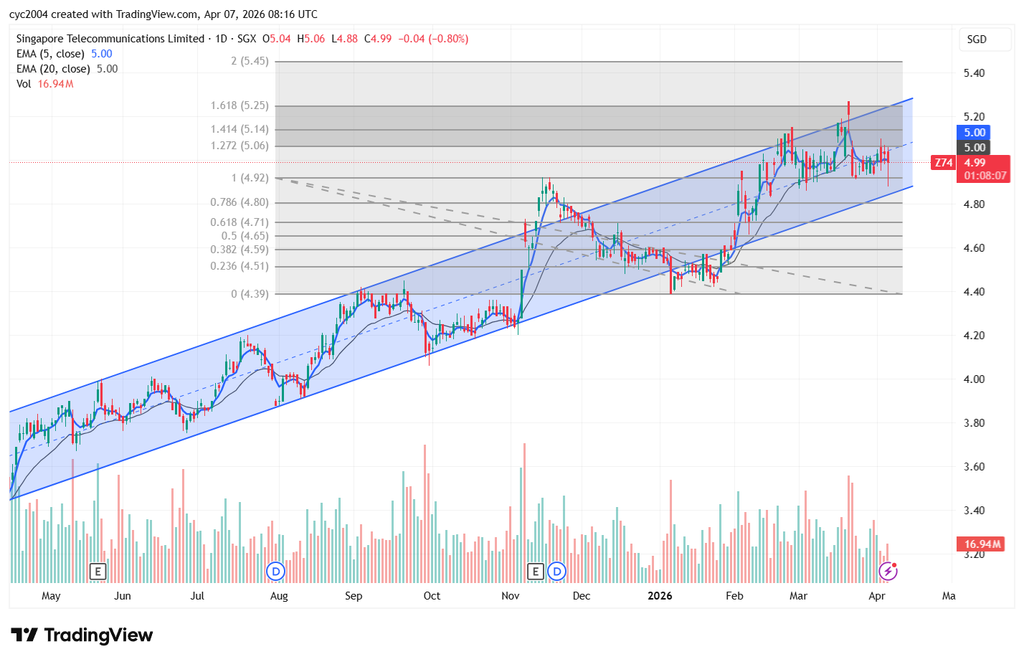
Trading session yet to close - A hammer in the making. Maybe can close above 5/20 EMA by 5pm.
JurongW ( Date: 07-Apr-2026 15:51) Posted:
|
tomorrow will be > 5 again.
Now rebounded, still down by 5 cents. Seems finding good support near bottom of ascending channel
JurongW ( Date: 07-Apr-2026 15:17) Posted:
|