


| Latest Forum Topics / UOB Last:38.8 -- |
 Post Reply Post Reply
|
|
UOB
|
||||||||||||||||||||
|
Joelton
Supreme |
26-May-2026 11:21
|
|||||||||||||||||||
|
x 0
x 0 Alert Admin |
High Court raps UOB over inconsistent legal positions on late mortgage payment charges [SINGAPORE] The High Court has criticised UOB over what it called the bank&rsquo s inconsistent legal positions on late payment charges in mortgage cases, after the lender repeatedly dropped such claims only when questioned by the court. In a written judgment on May 18, Assistant Registrar Randeep Singh Koonar said it was &ldquo unsatisfactory&rdquo that UOB persisted in making claims for late payment charges in court actions, but withdrew them when asked to justify the legal basis. The judgment was delivered on a 2026 case involving a mortgage action filed by UOB against a company that defaulted on a S$556,200 loan secured by a commercial unit at Oxley Bizhub in Ubi Road 1. But Randeep noted that on two other 2025 cases, the bank withdrew such claims after the High Court queried them. &ldquo UOB should take a principled and consistent position on its legal entitlement to impose the late payment charge,&rdquo the assistant registrar said. &ldquo (It&rsquo s) unsatisfactory for UOB to persist in making such claims but drop them once made to justify and defend their position.&rdquo In the current case, the bank took the company, SGmade Co-Operates, to court in March 2026. Accounting and Corporate Regulatory Authority records show that the company is a footwear retailer. The loan to SGmade Co-Operates was granted in June 2023 and was to be repaid over 312 monthly instalments. UOB issued its first demand letter in September 2025 after the borrower fell into arrears. A second demand letter followed in October 2025, when the bank recalled the loan and demanded full repayment of more than S$542,500. By December 2025, the bank had served a notice on the borrower and occupants to leave the premises within one month. In court, UOB sought orders for vacant possession of the property, repayment of the outstanding loan sum and an S$80 late payment charge for each missed instalment. The case was heard in the High Court on April 10, but the borrower did not turn up and remained unrepresented throughout the proceedings. Despite the borrower&rsquo s absence, which meant UOB&rsquo s applications were uncontested, the bank did not score an immediate walkover victory. The assistant registrar said: &ldquo (Even) in an unopposed application, it remained for UOB to satisfy the court that all the procedural and substantive requirements for granting the orders sought... were met.&rdquo Randeep questioned whether UOB could continue charging late fees after recalling the entire loan and demanding immediate repayment of the full amount. The High Court also criticised shortcomings in the bank&rsquo s court papers. The assistant registrar said UOB&rsquo s supporting affidavit failed to explain the contractual basis for recalling the loan and demanding full repayment. &ldquo It is insufficient for a claimant to make sweeping and unparticularised assertions in the supporting affidavit and leave the court and the defendant to pore over pages of contractual documents to decipher what its case is,&rdquo he said. UOB later amended its application and dropped the claims for late payment charges. When pressed by the High Court, the bank conceded that it was &ldquo not legally entitled to impose late payment charges on monthly instalments that fell due after the banking facilities had been terminated&rdquo . The assistant registrar agreed with the bank&rsquo s concession. The dispute centred on a standard clause in UOB&rsquo s facility letter imposing an $S80 fee &ldquo on each instalment payment not paid on due date&rdquo . Randeep said the wording of the loan agreement was &ldquo plain and unambiguous&rdquo because the late payment charge applied only to missed &ldquo instalment payments&rdquo . Once the bank recalled the loan and demanded full repayment, there were no longer monthly instalments to pay, he said. He added that while UOB could still impose late interest charges on the outstanding sum, it could not continue charging monthly late payment fees. The assistant registrar said the outcome was commercially sensible. If UOB decides not to terminate the facility, it may claim arrears, late interest and late payment charges, he said. But if the bank decides to terminate the facility and claim the full outstanding amount, it cannot claim payment of the late payment charge, he added. He also noted that while UOB ultimately conceded its position in the case, the point on late payment charges was worth addressing because similar clauses are commonly found in loan agreements issued by UOB and other banks. Although UOB eventually succeeded in obtaining possession orders and repayment of the outstanding loan sum, the High Court trimmed the bank&rsquo s legal costs request. UOB had sought S$8,000 in costs, but the High Court awarded S$7,500 instead. The bank was represented by Gracia Goh of Rajah & Tann Singapore. When contacted, a UOB spokesman said on Monday (May 25): &ldquo The bank accepts the court&rsquo s ruling that the late payment charge should not continue after the facility has been terminated and will follow this guidance moving forward.&rdquo |
|||||||||||||||||||
| Useful To Me Not Useful To Me | ||||||||||||||||||||
|
Joelton
Supreme |
15-May-2026 11:17
|
|||||||||||||||||||
|
x 0
x 0 Alert Admin |
DBS, UOB among lenders arranging US$2 billion AirTrunk&rsquo s loan for Malaysia growth Proceeds will support the firm&rsquo s 200-megawatt JHB2 facility located in Johor [KUALA LUMPUR] Blackstone-owned data centre firm AirTrunk is marketing a US$2.3 billion loan to fund a Malaysia project, according to people familiar with the matter, part of a slew of tech-linked financings in South-east Asia spurred by the artificial intelligence boom. Proceeds will support the firm&rsquo s 200-megawatt AirTrunk JHB2 facility located in the southern state of Johor, said the people, who asked not to be identified discussing private matters. About a dozen lenders &ndash including DBS, Credit Agricole, ING Bank and UOB &ndash are arranging the three-year loan, which is being syndicated to the broader market, the people said. Blackstone and AirTrunk declined to comment. Surging demand for AI capabilities has spurred data centre operators to take on more debt to expand. Moody&rsquo s Ratings expects at least US$3 trillion to flow into the sector over the next five years, with much of it financed through debt. Some investors, however have raised concerns about whether such investments will deliver sustainable returns. Recent deals underscore the trend. Digital Edge and power producer B Grimm Power this month announced an US$880 million facility, the largest-ever financing for a data centre project in Thailand. Bain Capital-owned Bridge Data Centres has also been in talks with lenders for a potential loan of up to US$6 billion for expansion in the country. In Malaysia, Singapore-based DayOne Data Centers has been seeking to double the size of an existing loan to as much as US$7 billion for its expansion plans. AirTrunk&rsquo s loan &ndash which carries two one-year extension options &ndash pays an interest margin of 225 basis points above the Secured Overnight Financing Rate for offshore financing and 235 basis points for onshore, the people said. The Sydney-headquartered firm is also looking to raise at least A$500 million (S$461.3 million) through asset-backed bonds for its data centre expansion, among the first for the region. |
|||||||||||||||||||
| Useful To Me Not Useful To Me | ||||||||||||||||||||
|
|
||||||||||||||||||||
|
Joelton
Supreme |
13-May-2026 10:15
|
|||||||||||||||||||
|
x 0
x 0 Alert Admin |
More upside ahead for DBS, OCBC, UOB as wealth fees power Q1 earnings
Their combined non-interest income rises to a record S$5.16 billion from S$4.78 billion the year before
[SINGAPORE] Wealth management and other fee income are becoming increasingly important earnings buffers for Singapore banks, and analysts expect non-interest income to continue offsetting expected declines in net interest income amid a falling interest-rate environment.
This trend came through in the first-quarter results of DBS : D05 +0.56%, OCBC : O39 -0.76% and UOB : O39 -0.76%, which all beat analysts&rsquo consensus estimates for the three months ended Mar 31, 2026.
The three lenders&rsquo combined non-interest income rose to a record S$5.16 billion in Q1, from S$4 billion in the preceding quarter and S$4.78 billion a year earlier, the Singapore Exchange&rsquo s (SGX) research team indicated in a market update last Friday (May 8).
This accounted for 39 per cent of the banks&rsquo total income.
At the same time, the trio reported combined net interest income of S$8.04 billion in Q1 &ndash breaching S$8 billion for the 14th straight quarter &ndash though this was down from S$8.24 billion in the previous quarter and S$8.44 billion in the year-ago period.
&ldquo The pivot to fee income-led growth to bolster profitability amid rate pressures stood out,&rdquo said Rena Kwok, senior credit analyst at Bloomberg Intelligence.
In the quarters ahead, &ldquo Singapore banks are likely to double down (on) their strategies to sustain wealth management fee momentum amid rate headwinds&rdquo , she added.
&ldquo Safe-haven inflows amid global uncertainties, driving new money for the lenders, is another lever.&rdquo
But she also said that the key risks ahead could include severe risk-off sentiment that hurts assets under management-based fees, or margin calls on lending to wealth clients during adverse market scenarios.
Wealth growth
The chief executives of all three lenders struck a bullish tone on their wealth management businesses during their respective earnings briefings, citing plans to recruit more wealth talent such as relationship managers.
For DBS, efforts to grow its wealth management franchise are &ldquo bearing fruit&rdquo , said CGS International (CGSI) Securities Singapore analysts Tay Wee Kuang and Lim Siew Khee in an Apr 30 note.
DBS led the three banks in wealth fee income, with record fees of S$907 million, up from S$724 million the year before.
The lender on Apr 30 posted a net profit that edged up 1 per cent to S$2.93 billion, higher than the S$2.88 billion consensus estimate in a Bloomberg survey of analysts.
This was as its non-interest income grew 10.3 per cent to S$2.45 billion in Q1, cushioning a 5 per cent fall in net interest income.
The CGSI analysts upgraded the counter to &ldquo add&rdquo from &ldquo hold&rdquo , with a new target price of S$63.80. The revision was due partially to stronger wealth management fee growth, which could allow DBS to &ldquo eke out&rdquo earnings growth in the 2026 financial year, they said.
In a May 4 report, RHB maintained its &ldquo buy&rdquo rating on DBS, with a new target price of S$64, up slightly from S$63.50 previously. This was partly on expectations of earnings being higher by 2 per cent a year until FY2028 from stronger non-interest income.
Over at OCBC, wealth management fees climbed 34 per cent to S$422 million. This helped to lift non-interest income by 23 per cent to S$1.61 billion and offset a 5 per cent decline in net interest income.
Net profit rose 5 per cent to S$1.97 billion, exceeding the S$1.88 billion consensus estimate.
Tay and Lim of CGSI maintained &ldquo hold&rdquo on the counter, also keeping their target price of S$23.30 unchanged, in a May 8 report.
Integration costs from the lender&rsquo s acquisition of HSBC&rsquo s wealth and retail business in Indonesia, which is expected to close in Q2 2027, could &ldquo weigh on&rdquo the franchise&rsquo s profitability post-acquisition, the analysts said.
RHB on May 11 kept its &ldquo buy&rdquo rating on OCBC with a target price of S$24.65, after raising its earnings forecasts for the lender until 2028, on expectations of higher non-interest income.
Meanwhile, UOB is betting on wealth management to become a larger contributor to its earnings over time.
The bank&rsquo s wealth fees registered a modest 2.8 per cent increase to S$219 million, from S$213 million in the year-ago period.
This was despite an overall decline of 11.9 per cent in non-interest income, alongside a 4 per cent fall in net interest income. This brought net profit down 4 per cent to S$1.44 billion, although this still beat expectations.
UOB' s profitability could improve only in the second half of FY2026, the CGSI analysts said in another report on May 8.
They cited support from higher wealth management fees from new product launches, as well as other measures to drive new-money inflows following its acquisition and integration of Citigroup&rsquo s consumer banking franchise.
They maintained &ldquo hold&rdquo on the stock, with a target price of S$38.70.
Also on May 8, RHB kept its &ldquo neutral&rdquo rating on UOB, with S$39.50 as the target price. The brokerage believes &ldquo its valuation is decent and fairly reflects asset-quality risks and the lower provision coverage level (versus) the sector&rdquo .
Commenting on UOB&rsquo s target of doubling wealth income to at least S$2.5 billion by 2030, Morningstar equity analyst Kathy Chan noted that the business is still &ldquo a relatively small contributor&rdquo . She estimates that it would make up 15 per cent of the top line in that year.
However, she raised her forecast for the lender&rsquo s non-interest income growth rate to 6 per cent a year from 5 per cent annually for FY2026 to FY2030.
Credit quality
Beyond wealth management, the SGX research team noted that non-interest income growth across the three lenders was &ldquo broad-based&rdquo and also reflected stronger contributions from fee income, treasury customer sales, trading income and insurance.
Still, analysts cautioned that &ndash amid the ongoing Middle East conflict &ndash credit risks remained key to watch.
Bloomberg&rsquo s Kwok said that credit costs are &ldquo likely to be within guidance for Singapore banks in 2026&rdquo , given their &ldquo sound asset quality&rdquo and &ldquo already ample provision coverage&rdquo .
While second and third-order effects such as higher logistics and material costs stemming from the Iran war could have a broad impact on businesses, the Singapore banks&rsquo &ldquo tight underwriting record&rdquo should allow them to absorb potential credit losses if headwinds worsen, she added.
Shares of DBS closed Tuesday 0.6 per cent higher at S$59.10, while those of OCBC fell 0.8 per cent to S$22.33. UOB rose 0.3 per cent to finish at S$37.11.
|
|||||||||||||||||||
| Useful To Me Not Useful To Me | ||||||||||||||||||||
|
Joelton
Supreme |
09-May-2026 09:50
|
|||||||||||||||||||
|
x 0
x 0 Alert Admin |
UOB beats estimates, announces franchise shift to wealth management United Overseas Bank (UOB) reported 1QFY2026 ended March 31 net profit of $1.437 billion, which was above the latest Bloomberg estimates of $1.39 billion, or a 3.3% beat. Net profit was up 2% q-o-q but down 4% y-o-y. Net interest income moderated 1% q-o-q and 4% y-o-y to $2.3 billion while net interest margin (NIM) narrowed 2 basis points (bps) q-o-q to 1.82%. Exit NIM was 1.83%. Net fee income increased 2% q-o-q but fell 8% y-o-y to $637 million. Other non-interest income rose 45% q-o-q but declined 17% y-o-y to $462 million. UOB kept its FY2026 guidance unchanged, with low single-digit loan growth, full-year NIM of 1.75%&ndash 1.80%, high single-digit fee growth, low single-digit operating cost growth, and total credit costs at 25&ndash 30 bps. JP Morgan says: &ldquo Numerically, UOB beat our 1QFY2026 estimates by 5%. Our full-year estimates are 6% below Bloomberg consensus, which suggests, at best, an in-line set of results. Yet, given the high bar set by DBS in 1QFY2026, we believe these numbers may not be a driver for the stock in either direction.&rdquo JP Morgan remains bullish on DBS, which announced its 1QFY2026 net profit of $2.93 million, up 30% q-o-q and 1% y-o-y, on April 30. It was 2% above JP Morgan&rsquo s own 1Q estimate and about a 2% beat compared to Bloomberg&rsquo s consensus. JP Morgan says: &ldquo [UOB&rsquo s] treasury income was quite firm, up $150 million q-o-q to $364 million (19% of pre-provisioning operating profit or PPoP), which in our view deserves lower multiples vs most other business lines. Fee growth was weak at 2% q-o-q despite seasonality, and down 8% y-o-y. This is an important contrast to DBS, which was up 35% and 16% q-o-q and y-o-y, respectively. We expect these trends to hold well at OCBC too. We worry that the weaker wealth management franchise at UOB could continue to be a drag on fees for a few quarters.&rdquo A lower cost-to-income ratio of 44.5%, down 1.9 percentage points y-o-y, was the main driver of the UOB&rsquo s PPoP beat, JP Morgan observes. Non-performing loans (NPL) were slightly better at 1.5% with credit costs at 24 bps, which was &ldquo a beat versus our forecasts&rdquo , the JP Morgan report indicates. UOB&rsquo s US portfolio quality improved in line with the 4Q2025 guidance, with NPL halving q-o-q to 1.5% with coverage at 233%. Group CEO Wee Ee Cheong announced a modest franchise shift: &ldquo Our immediate focus is to grow assets under management (AUM) and improve invested AUM penetration. Our ambition is to double wealth income by 2030 through discipline, organic execution, people and solutions.&rdquo UOB' s FY2025 wealth income was $1.281 billion Wee also emphasised UOB&rsquo s Asean footprint as a source of growth. &ldquo Over the past three years, our focus has been on integrating the Citi portfolio and bringing everything into a single, unified platform. That work is largely completed and positions us as one of the most connected banking franchises in Asean. We are moving into the next phase now, unlocking the value of our enlarged customer base to reshape the group towards a more diversified, fee-driven mix anchored on connectivity, trade and cash (management), lifestyle solutions like credit cards and wealth. We see significant opportunities, including in wealth, underpinned by a large and increasingly affluent customer base that is under-penetrated. This gives us a long runway for sustainable, organic growth,&rdquo Wee elaborates. On April 30, during a media briefing, DBS&rsquo s group CEO Tan Su Shan acknowledged that the environment in India and Indonesia is challenging: &ldquo We have been stress testing for rupee and rupiah volatility, which is why we have been fairly conservative in India and Indonesia. We reduced our unsecured consumer and SME exposures in these two markets, and to a smaller extent in China.&rdquo Wee says Indonesia is 3% of UOB&rsquo s total exposure. &ldquo We are still growing our consumer [banking], mortgages and SMEs. We have to stand by our customers. This is not the time to de-risk,&rdquo he says, repeating UOB&rsquo s tagline &ldquo Right by you&rdquo . UOB&rsquo s Group CFO Leong Yung Chee says that in Indonesia, UOB&rsquo s retail focus is on its affluent customer base. &ldquo Likewise, for wholesale banking, our focus is guided by our sector solutions group. We&rsquo ve identified seven specific industries: TMT [technology, media and telecommunications], consumer goods, industrial, construction and infrastructure, real estate, hospitality, energy and chemicals, and healthcare. In Singapore, because it&rsquo s our home market, we are more broad-based. Outside of Singapore, it&rsquo s more targeted, because there&rsquo s information asymmetry,&rdquo he elaborates. JP Morgan&rsquo s report says the DBS franchise &ldquo is on track to gain market share across profit pools. We expect re-rating for DBS to continue. With every passing quarter, our characterisation of DBS as the &lsquo JPM of Asia&rsquo appears truer&rdquo . The valuation disconnect between DBS and UOB is stark. DBS&rsquo s P/B ratio of 2.42 times as at May 7 and its dividend yield of 5.3% are at a premium to UOB&rsquo s P/B of 1.22 times and dividend yield of 4.3%. Perhaps investors should hedge their bets across all three local banks and JP Morgan, which last traded at a P/B of 2.45 times. |
|||||||||||||||||||
| Useful To Me Not Useful To Me | ||||||||||||||||||||
|
Joelton
Supreme |
08-May-2026 10:21
|
|||||||||||||||||||
|
x 0
x 0 Alert Admin |
UOB aims to double wealth income to at least S$2.5 billion by 2030 Q1 profit slips 4% CEO Wee Ee Cheong said on Thursday that the completion of its Citi integration gives the bank a &ldquo long runway&rdquo for organic wealth growth across Asean [SINGAPORE] UOB has set a target of doubling its wealth management income by 2030, as it looks to deepen penetration of what it sees as an &ldquo underpenetrated&rdquo affluent segment across Asean to drive its next phase of growth, deputy chairman and chief executive officer Wee Ee Cheong said on Thursday (May 7). The target will be benchmarked against the figures for the 12 months ended Dec 31, 2025. In FY2025, UOB&rsquo s wealth management income rose to S$1.28 billion, from S$1.12 billion a year earlier. The latest goal implies that the lender is aiming for wealth management income of at least S$2.5 billion by 2030, following the completion of its acquisition of Citigroup&rsquo s retail banking assets in four Asean markets. &ldquo Over the past three years, our focus has been on integrating the Citi portfolio and bringing everything into a single, unified platform,&rdquo Wee said at the bank&rsquo s first-quarter results briefing. &ldquo That work is largely completed.&rdquo He was referring to UOB&rsquo s S$4.9 billion acquisition of Citigroup&rsquo s retail banking businesses in Indonesia, Malaysia, Thailand and Vietnam. The deal, first announced in 2022 and completed in 2025, doubled UOB&rsquo s customer base in those four markets to 8.5 million. Wee acknowledged that the integration had been &ldquo not as straightforward&rdquo as initially expected, noting that the bank had to continue operating Citi&rsquo s platforms while simultaneously building its own systems, a process that cost an &ldquo arm and leg&rdquo . However, he said the integration work has now been completed, with the associated costs already recognised in previous quarters. Looking ahead, he sees &ldquo significant opportunities&rdquo in wealth management, supported by &ldquo a large and increasingly affluent customer base that is underpenetrated&rdquo . &ldquo This gives us a long runway for sustainable, organic growth,&rdquo said Wee. Investors will begin to see income from the wealth business &ldquo picking up&rdquo over the coming quarters, he added, as the lender works towards its 2030 target. To support its wealth ambitions, UOB plans to expand hiring for wealth-related roles such as relationship managers, although overall headcount is expected to remain broadly stable. On inorganic growth opportunities such as acquisitions, Wee said the bank is not ruling them out, though valuations are likely to remain &ldquo very high&rdquo . &ldquo Other people don&rsquo t have (our) customer base,&rdquo he said. &ldquo I have the customer base &ndash that is a key differentiator.&rdquo His remarks came just days after OCBC announced on Monday that it would acquire HSBC Indonesia&rsquo s retail and wealth business, with the transaction expected to close in the second quarter of 2027. DBS, OCBC and UOB had all reportedly been among the bidders for the business. Elaborating on UOB&rsquo s acquisition strategy, chief financial officer Leong Yung Chee said the lender remains &ldquo always on the lookout for opportunities, whether previously or going forward&rdquo , but added that any deal must &ldquo check quite a few boxes&rdquo . These include whether an acquisition brings desired capabilities, fills business or geographical gaps, and comes at the &ldquo correct&rdquo price. Integration costs must also be factored in alongside acquisition costs, Leong added. Q1 profit slips on lower rates The lender on Thursday reported a 4 per cent decline in net profit to S$1.44 billion for the three months ended Mar 31, 2026, although the results beat the S$1.39 billion consensus estimate in a Bloomberg survey. Net interest income fell 4 per cent to S$2.32 billion as lower benchmark rates weighed on margins. Net interest margin narrowed by 18 basis points to 1.82 per cent, from 2 per cent a year earlier, amid lower benchmark rates in Singapore and Hong Kong. Net fee income slipped 8 per cent year on year to S$637 million, easing from the previous year&rsquo s record high as investment banking and loan-related activities moderated amid cautious, risk-off sentiment. Other non-interest income fell 17 per cent year on year to S$462 million, mainly due to softer trading and investment income. Total income declined 6 per cent to S$3.42 billion in Q1, from S$3.66 billion a year earlier. Management maintained its FY2026 guidance, unchanged from three months ago. The bank continues to expect low single-digit loan growth, a full-year net interest margin of between 1.75 per cent and 1.8 per cent, and high single-digit fee growth. Guidance for operating cost growth, at low single digits, and credit costs of between 25 and 30 basis points, was also unchanged. Customer loans rose 4 per cent year on year to S$354 billion in Q1. On interest margins, Leong said the bank&rsquo s house view remains that the US Federal Reserve will cut rates once in 2026, though the relationship between US rates and Singapore rates has &ldquo significantly decoupled&rdquo . UOB is &ldquo a lot more sensitive&rdquo to Sora, which has more &ldquo limited downside&rdquo , he said, adding that the lender remains on track to meet its net interest margin guidance. Addressing the ongoing Middle East conflict, Wee said the bank&rsquo s direct exposure to the region is &ldquo quite insignificant&rdquo , with Leong putting Middle East loan exposure at about 2 per cent of the bank&rsquo s total loans. However, Wee noted that second-order effects from elevated oil and energy prices could weigh more heavily on small and medium-sized enterprises (SMEs), although the bank is still conducting stress tests to assess the potential impact. On whether UOB may add provisions to guard against the formation of new bad loans, Leong said the bank is continuing to monitor developments closely. He noted that UOB&rsquo s general provision coverage has remained at 1 per cent for three straight quarters, after the lender pre-emptively added more than S$600 million in provisions in the third quarter of FY2025. UOB&rsquo s non-performing loans ratio improved to 1.5 per cent in Q1, from 1.6 per cent a year earlier. New non-performing asset formation &ndash largely on real estate exposure in Greater China &ndash fell to S$341 million in the quarter, from S$400 million a year ago. At the briefing, Wee also stressed that the bank would continue supporting its SME customers, after being asked whether UOB would de-risk its SME portfolio. &ldquo In fact, this is the time &ndash especially the SMEs &ndash you have to stand by them,&rdquo he said. &ldquo This is not the time to de-risk.&rdquo UOB was the second of Singapore&rsquo s three local banks to report first-quarter results, after DBS released its numbers on Apr 30. OCBC is due to report on Friday. |
|||||||||||||||||||
| Useful To Me Not Useful To Me | ||||||||||||||||||||
|
|
||||||||||||||||||||
|
Joelton
Supreme |
08-May-2026 10:21
|
|||||||||||||||||||
|
x 0
x 0 Alert Admin |
UOB gunning to double wealth income by 2030 United Overseas Bank (UOB) is aiming to double its wealth income over the next five years, says UOB&rsquo s deputy chairman and CEO Wee Ee Cheong during the bank&rsquo s earnings briefing for 1QFY2026 on May 7. &ldquo Our ambition is clear, to double wealth income by 2030 through discipline, organic execution, platform, people and solution,&rdquo Wee says, noting that the space has grown increasingly competitive. UOB&rsquo s net fee and commission income from its wealth management business grew by 18% y-o-y from $698 million in FY2024 to $822 million in FY2025. UOB&rsquo s local rivals, DBS Group Holdings and Oversea-Chinese Banking Corporation (OCBC) have been making inroads on wealth management as well. During DBS&rsquo s earnings briefing for 1QFY2026, the bank&rsquo s group executive and group head of consumer banking and wealth management Shee Tse Koon told reporters that the bank&rsquo s wealth arm is in &ldquo growth mode&rdquo and that there is a &ldquo rapid growth of wealth within Asia.&rdquo &ldquo So, we&rsquo re hiring on all fronts across all three segments, [DBS] Treasures, Treasures Private Client and Private Bank.&rdquo On May 4, OCBC announced that its Indonesian subsidiary, PT Bank OCBC NISP Tbk (OCBC Indonesia) was acquiring PT Bank HSBC Indonesia (HSBC Indonesia)&rsquo s retail banking and wealth management operations in Indonesia for a premium of $480 million. The deal is expected to raise OCBC Indonesia&rsquo s assets under management (AUM) by 25%, grow its credit card balances by more than 150% and raise its wealth management talent pool by an additional 1,300 staff. Protecting customers over growing AUM Wee, however, says UOB will be adopting a more cautious approach to grow their wealth management income. Instead of trying to draw in capital quickly to boost their AUM numbers, UOB wants to build up a long-term relationship with their customers and win their trust. This means the bank is willing to forgo some fee income in the short-term if it can help strengthen customer loyalty. &ldquo [Our] relationship managers will target new customers but my existing customer base of eight over million. This is where the low hanging fruit is and this is why we are very, very confident,&rdquo Wee says. &ldquo The next few quarters, I cannot tell you the number, [but] we will definitely increase the AUM.&rdquo &ldquo We are conservative. We want to protect our customers. You don&rsquo t just ask them [and] take [their] money, because today the environment is very uncertain. I would rather they be safe. We can earn less fees but I want them to be safe. When opportunity comes? This is where the potential is.&rdquo That applies to the bank&rsquo s view on using mergers and acquisitions to grow its wealth business as well. While Wee did not rule out making any acquisitions down the line, he emphasised that any acquisition target would have to fit with the bank&rsquo s overall strategy. &ldquo Everybody is focusing on wealth, right? [If] there is opportunity, I believe the price will be very high. [At the] end of the day, [it has] got to make sense. What makes sense to me at this point? I&rsquo m not ruling out inorganic growth,&rdquo Wee says. For UOB, deciding whether to pull the trigger on an acquisition goes beyond looking at the sticker price of a deal, says the bank&rsquo s group CFO Leong Yung Chee. &ldquo Whether the opportunities make sense, it has to check quite a few boxes,&rdquo Leong says. &ldquo Whether it meets our strategy? Does it meet certain capabilities that we want? Are they filling certain business gaps that we don&rsquo t have, or geographical gaps? Ultimately, is the price to pay, correct?&rdquo &ldquo It&rsquo s not just a dollar price. Don&rsquo t forget, there&rsquo s also integration cost. Going forward, do you think the cost synergies and revenue synergies are going to make sense for you? So, the calculation isn&rsquo t just about the transaction price, but the cost of the entire project itself has to make sense.&rdquo Second order impact from Middle East may affect SMEs Any first order impact to UOB&rsquo s book from the conflict in the Middle East is limited, given that loans for companies with direct geographical exposure make up less than 2% of its total book, says Leong. However, second order effects from the crisis may affect the bank&rsquo s small- and medium-sized enterprise (SME) customers. While the bank is currently undertaking stress analysis, things are still &ldquo too early to tell&rdquo at this point because everything is &ldquo fluid&rdquo , says Wee. Leong notes that the bank&rsquo s focus is on the second order effects, which may impact energy vulnerable industries such as transport, basic materials, utilities and agriculture. &ldquo We&rsquo re looking at assessing how much of these industries and clients who are in these industries may be affected as a result.&rdquo The third order is harder to determine given that there is no clear view on how long this conflict will take. &ldquo There is potential impact on overall Asia' s economic growth environment, inflationary practices and so on. So that actually requires much further stress scenarios,&rdquo he says. UOB, which considers interest rates, property price indices, unemployment rates, consumer price indices, gross domestic products and equity price indices in its macro-economic variable (MEV), says it is starting to take some of the uncertainties from the Middle East into account. Given that tensions began in late February, Leong says the bank will continue to monitor the situation. Any changes to the MEV should be adjusted in the following quarters, he adds. &lsquo Not the time to de-risk&rsquo Unlike DBS, which has chosen to de-risk its SME and consumer franchise in India and Indonesia, UOB prefers to stay put. The bank, which also has a presence in Indonesia, says the country&rsquo s loans make up 3% of its total book. &ldquo It&rsquo s easy to talk about de-risking. [At the] end of the day, it&rsquo s the origination, you look at the customer, employers, employment track record&hellip We' re still growing. You look at the consumer, look at the mortgages&hellip This is a time especially [for] SMEs, you have to stand by them,&rdquo says Wee. &ldquo This is not the time to de-risk. |
|||||||||||||||||||
| Useful To Me Not Useful To Me | ||||||||||||||||||||
|
sfw2124
Senior |
07-May-2026 08:41
|
|||||||||||||||||||
|
x 0
x 0 Alert Admin |
Based on the previous reports and the latest market updates from April 2026, here is the consolidated and validated narrative regarding United Overseas Bank&rsquo s (UOB) strategic performance and growth drivers. Executive Summary: The " Connectivity" Strategy UOB is currently executing a two-pronged growth strategy: capturing high-growth cross-border flows within the Johor-Singapore Special Economic Zone (JS-SEZ) and scaling its retail presence across ASEAN following the integration of Citigroup&rsquo s regional assets. While facing global macroeconomic headwinds, the bank maintains a fortress balance sheet with a 15.3% CET1 ratio and zero direct exposure to the volatile US private credit market. UOB has positioned itself as the primary financial architect of the Johor-Singapore Special Economic Zone.
The S$4.9 billion acquisition of Citigroup&rsquo s retail businesses in Indonesia, Malaysia, Thailand, and Vietnam is now delivering tangible results.
During its April 2026 Annual General Meeting (AGM), UOB addressed key investor concerns regarding global stability:
|
|||||||||||||||||||
| Useful To Me Not Useful To Me | ||||||||||||||||||||
|
sfw2124
Senior |
07-May-2026 08:20
|
|||||||||||||||||||
|
x 0
x 0 Alert Admin |
UOB (U11) 1Q 2026 Results Analysis: Resilient Core Amid Rate Headwinds 1. Financial Performance Summary (1Q26 vs. 1Q25/4Q25) UOB reported a net profit of S$1.44 billion, which beat the Bloomberg consensus estimate of S$1.39 billion.
While DBS continues to lead in absolute profit growth and aggressive capital returns (special dividends), UOB&rsquo s strategy focuses on the " ASEAN connectivity" play.
Assessment: HOLD / ACCUMULATE ON WEAKNESS
|
|||||||||||||||||||
| Useful To Me Not Useful To Me | ||||||||||||||||||||
|
|
||||||||||||||||||||
|
SDEXXXXD
Veteran |
07-May-2026 07:26
|
|||||||||||||||||||
|
x 0
x 0 Alert Admin |
? First quarter 2026 net profit of $1.4 billion, underscoring the resilience of the Group?s franchise and supported by broad-based income streams ? Net interest income moderated, with net interest margin narrowing to 1.82%, in line with the prevailing rate environment ? Net fee income stood at $637 million, supported by sustained momentum in core fee drivers, with card fees normalising from last quarter's seasonal high ? Trading and investment income rebounded to $405 million, driven by stronger customer treasury flows alongside robust trading and liquidity management performance ? Asset quality remained stable with NPL ratio at 1.5% and NPA coverage at 100% or 272% after taking collateral into account ? Total credit costs within expectations at 26bps ? Strong capital and funding positions maintained, supporting the ability to navigate ongoing market volatility |
|||||||||||||||||||
| Useful To Me Not Useful To Me | ||||||||||||||||||||
|
Joelton
Supreme |
21-Apr-2026 11:31
|
|||||||||||||||||||
|
x 0
x 0 Alert Admin |
UOB&rsquo s Green Lane facilitates RM18 billion of FDI into JS-SEZ since 2024 with more to come Following the launch of United Overseas Bank&rsquo s Green Lane with Invest Johor in February 2025, the bank announced that it has facilitated foreign direct investments (FDI) flows exceeding RM18 billion into the Johor-Singapore Special Economic Zone (JS-SEZ) as at end- 2025. The figures were revealed on April 20 by UOB at the UOB-Invest Johor JS-SEZ Strategic Forum 2026 which saw Johor Menteri Besar Dato&rsquo Onn Hafiz bin Ghazi present the JS-SEZ top investors award. In addition, UOB also announced that the Green Lane will facilitate two new investor commitments of more than RM1 billion. GSP Automotive Malaysia and Paragon Globe jointly provided a commitment while the other was from JT Automation Technology. Speaking at the event which was attended by The Edge Singapore, Onn Hafiz says that the collaboration between UOB and Invest Johor has delivered tangible outcomes. &ldquo The strong partnership between Invest Johor and UOB reflects how well-aligned public-private collaboration can deliver real results, attracting high-quality investments, creating skilled jobs and generating meaningful impact on the ground,&rdquo he says. &ldquo Every investment secured must translate into real outcomes, including better job opportunities, stronger local industries and lasting value for every Johorean.&rdquo Against the backdrop of the Middle East conflict, Onn Hafiz believes that collaboration is critical in an era defined by geopolitical tension and economic volatility, with the JS-SEZ potentially serving as a &ldquo key catalyst&rdquo of growth for Southeast Asia. &ldquo It is precisely in times like these that cooperation exemplified by the JS-SEZ should be doubled down rather than abandoned,&rdquo he says. &ldquo Johor is moving with a renewed sense of purpose [and] this progress is not by chance, but driven by deliberate policies, strong leadership and close partnership with our neighbor.&rdquo Since the formalisation of the JS-SEZ in January 2025, investors have poured a record RM110 billion in approved investments into the southernmost state of Peninsular Malaysia. UOB Malaysia CEO Ng Wei Wei says that UOB will continue to contribute to the development of the JS-SEZ. She says: &ldquo From the outset, UOB has focused on practical enablers to turn interest into action. Combining Johor&rsquo s development priorities with Singapore&rsquo s role as a global business hub enables companies on both sides of the Causeway to execute cross-border opportunities effectively. &ldquo Partnering Invest Johor, MIDA, IRDA and other stakeholders, we continue to facilitate high value investments into the JS-SEZ from multiple countries, strengthening supply chain connectivity while delivering economic benefits for Malaysia and Singapore.&rdquo Ng also says that the bank is committed to developing future-ready talent for the digital age. During the event, UOB took the opportunity to launch its UOB My Digital Space (MDS) in Malaysia, an education initiative designed to empower students to think critically and use technology responsibly. &ldquo We are proud to officially launch the bank' s flagship education programme in Malaysia, starting with Johor,&rdquo adds Ng. According to UOB, the MDS has been implemented in Singapore, Malaysia, Indonesia, Thailand, Vietnam, China and Hong Kong and is expected to benefit more than 100,000 students regionally, helping to bridge the digital divide. The programme focuses on educating students aged 10 to 16 years. |
|||||||||||||||||||
| Useful To Me Not Useful To Me | ||||||||||||||||||||
|
JurongW
Elite |
18-Apr-2026 16:44

Yells: "Earnings give weight, Chart give wings" |
|||||||||||||||||||
|
x 0
x 0 Alert Admin |
If STI can go up to 5200 this year, UOB should be able to retest its previous high of $39.50 | |||||||||||||||||||
| Useful To Me Not Useful To Me | ||||||||||||||||||||
|
Joelton
Supreme |
18-Apr-2026 16:36
|
|||||||||||||||||||
|
x 0
x 0 Alert Admin |
UOB&rsquo s Wee Ee Cheong says S$4.9 billion Citi deal &lsquo paying off&rsquo as Asean push accelerates The lender also flags minimal private credit exposure, and says its balance sheet can absorb Middle East shocks [SINGAPORE] UOB&rsquo s S$4.9 billion acquisition of Citigroup&rsquo s retail banking businesses in Indonesia, Malaysia, Thailand and Vietnam is now &ldquo paying off&rdquo , as the lender steps up its push into Asean, said its deputy chairman and chief executive Wee Ee Cheong. The deal, first announced in 2022, has helped double UOB&rsquo s customer base across the four markets, after a &ldquo fair bit of time&rdquo was needed to integrate the acquired businesses, he said on Friday (Apr 17). He was responding to shareholder questions at the bank&rsquo s annual general meeting (AGM) at the Sands Expo and Convention Centre. &ldquo We must then continue to invest in the infrastructure to capture customers,&rdquo said Wee, noting that Asean customers are not a homogenous group, with each market having different languages and customer needs. That means continued investments in areas such as the alignment of technology platforms to better serve customers, as well as broader spending plans for the decade leading up to the bank&rsquo s centenary, he added, in response to a shareholder question on the bank&rsquo s growth plans for the next 10 years. UOB marked its 90th anniversary in 2025. The four markets make up UOB&rsquo s &ldquo Asean-4&rdquo segment, which posted total income growth of 5 per cent for the 12 months ended Dec 31, 2025, outperforming the group, where total income fell 3 per cent. Even as UOB expands its regional capabilities, the bank remains disciplined about how it competes. For instance, while domestic lenders are strong in their home markets, they &ldquo have hardly any presence&rdquo outside their own countries, leaving UOB well-placed to &ldquo align the Asean interest in connectivity&rdquo , Wee noted. &ldquo We should be able to double down on wealth because we have the customer base,&rdquo he said. &ldquo It would be unwise for us not to take advantage.&rdquo On wholesale banking, he said strong foreign direct investment inflows into Asean and robust trade loan growth in FY2025 also present opportunities. Private credit, Middle East risks Another shareholder question centred on UOB&rsquo s exposure to private credit, amid ongoing stresses in the US private credit market. Wee said the lender has no direct exposure to private credit, while any indirect exposure is &ldquo very immaterial&rdquo . &ldquo Singapore (is) full of banks, you don&rsquo t need private credit,&rdquo he quipped. Asked how the ongoing war in the Middle East could affect the bank, particularly among small and medium-sized enterprise borrowers, Wee said stress tests indicate the lender &ldquo should be able to manage&rdquo . Its balance sheet is also &ldquo strong enough&rdquo to absorb potential bad loans, he said, when asked if UOB expects additional provisions. UOB has guided for credit costs to normalise to 25 to 30 basis points in FY2026, after total credit costs rose to 55 basis points in FY2025, following additional pre-emptive provisions booked in the previous financial year. UOB was the last of Singapore&rsquo s three local banks to conduct its AGM &ndash all at the same venue &ndash after DBS held its meeting on Mar 31 and OCBC had its AGM on Apr 16. Resolutions passed at Friday&rsquo s AGM included one to re-elect Wee as a board director. He has served on the board since January 1990, as deputy chairman since March 2000, and as chief executive since April 2007. Shares of UOB closed 0.3 per cent or S$0.12 lower at S$37.40 on Friday. In the year to date, the counter is up 6.1 per cent. |
|||||||||||||||||||
| Useful To Me Not Useful To Me | ||||||||||||||||||||
|
|
||||||||||||||||||||
|
Joelton
Supreme |
18-Apr-2026 16:35
|
|||||||||||||||||||
|
x 0
x 0 Alert Admin |
CRE, Middle East, gold and directors' fees among questions at UOB&rsquo s AGM Questions posed at United Overseas Bank&rsquo s (UOB) 84th annual general meeting (AGM) ranged from its loan book and commercial real estate (CRE) to gold, private credit and directors&rsquo fees. In November 2025, UOB announced &ldquo pre-emptive&rdquo general provisions of $615 million amid macro uncertainties and sector-specific headwinds. A key driver of the pre-emptive general provision (GP) was due to the declines in collateral valuations in commercial real estate (CRE) in Hong Kong and the US. At the AGM on April 17, group CFO Leong Yung Chee said that the HK CRE sector remains &ldquo fairly nuanced&rdquo at the moment and believes the situation will take some time to be resolved. Meanwhile, the bank saw an improvement in recoveries for the US, as reported in its results for the 4QFY2025 ended Dec 31, 2025. Gold &lsquo a very hot item&rsquo Other questions centred on the bank&rsquo s gold bullion following sharp spikes in gold prices last year. Deputy chairman and CEO Wee Ee Cheong described the business as &ldquo profitable&rdquo but declined to elaborate further as it is confidential. He added that the business is also &ldquo not material enough&rdquo , which is why it is not disclosed. Wee also noted that the bank is seeing more interest in the precious metal when gold prices are high. &ldquo Gold is a very hot item today,&rdquo he adds. On Singapore&rsquo s plan to become a gold trading hub, Wee said the move is &ldquo the right thing to do&rdquo and the bank is &ldquo part of the team&rdquo along with other local and foreign banks. UOB, given that it is the only bank selling physical gold, has an advantage as taking physical custody is going to be &ldquo very, very expensive&rdquo . When asked if the bank intended to tokenise gold into crypto, chairman Wong Kan Seng said that the bank had &ldquo no plans&rdquo at the moment. Banks over private credit UOB &lsquo able to manage&rsquo if war drags out UOB has no direct exposure on private credit, save for an &ldquo immaterial&rdquo indirect stake. &ldquo I personally don&rsquo t like private credit,&rdquo says Wee, adding that investors should turn to banks to finance their needs instead, as it is safer given that the banks are regulated by the Monetary Authority of Singapore (MAS). On the Middle Eastern conflict, the situation is &ldquo still very fluid&rdquo although the bank is monitoring the situation closely. While the unintended consequences could be worse if the war is protracted, Wee says the bank&rsquo s management has conducted stress tests and found that it &ldquo should be able to manage&rdquo . He adds that the bank will also look at helping its customers, as its balance sheet is &ldquo strong enough&rdquo and that it has a &ldquo social responsibility&rdquo to do so. Directors&rsquo fees On directors&rsquo fees, which totalled $4.45 million, Tracey Woon, independent director and chairman of the remuneration and human capital committee, said the disparity between the compensation of the members and the chairman has been the practice &ldquo for some time&rdquo . &ldquo I think it&rsquo s pretty standard,&rdquo she says. &ldquo Not least, we have to thank our chairman he works really hard as well.&rdquo Woon also noted that the compensation was also to attract the right talent and that the last revision was five years ago. All the board directors take 30% of their fees in shares, and, as long as they remain on the board, they will not sell their shares, she adds. All resolutions were passed. Shares in UOB closed 12 cents lower or 0.32% down at $37.40 on April 17. |
|||||||||||||||||||
| Useful To Me Not Useful To Me | ||||||||||||||||||||
|
JurongW
Elite |
17-Apr-2026 17:51
Yells: "Earnings give weight, Chart give wings" |
|||||||||||||||||||
|
x 0
x 0 Alert Admin |
CEO presentation at UOB AGM https://links.sgx.com/1.0.0/corporate-announcements/71HKOVYDZ716XVWQ/884581_UOB%20AGM%202026%20-%20CEO%20presentation.pdf |
|||||||||||||||||||
| Useful To Me Not Useful To Me | ||||||||||||||||||||
|
JurongW
Elite |
14-Apr-2026 20:48
Yells: "Earnings give weight, Chart give wings" |
|||||||||||||||||||
|
x 0
x 0 Alert Admin |
UOB will release its 1Q26 Performance Highlights on 7 May 2026, before trading commences. |
|||||||||||||||||||
| Useful To Me Not Useful To Me | ||||||||||||||||||||
|
JurongW
Elite |
09-Apr-2026 23:39
Yells: "Earnings give weight, Chart give wings" |
|||||||||||||||||||
|
x 0
x 0 Alert Admin |
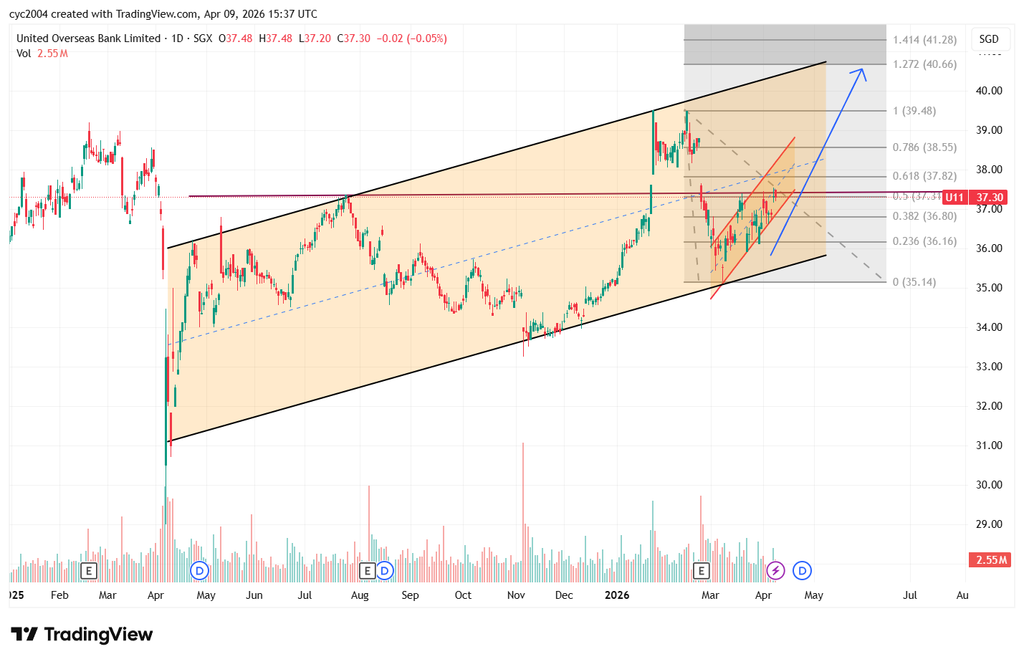
|
|||||||||||||||||||
| Useful To Me Not Useful To Me | ||||||||||||||||||||
|
Joelton
Supreme |
26-Mar-2026 09:23
|
|||||||||||||||||||
|
x 0
x 0 Alert Admin |
UOB establishes foundation to scale CSR initiatives for education, children, arts It will be operational from the second half of 2026 [SINGAPORE] UOB on Wednesday (Mar 25) announced that it is establishing the UOB Foundation to scale its corporate social responsibility (CSR) initiatives across the region. It will provide a sustained platform for the bank to continue giving back towards the causes of education, children and the arts. Janet Young, chairman of UOB Foundation, said the foundation &ldquo reflects our commitment&rdquo to ensure that &ldquo future generations are given the chance to thrive&rdquo , &ldquo education opens doors&rdquo , and &ldquo the arts and culture continue to bring meaning, connection and strength to our communities&rdquo . The bank will spearhead initiatives in these areas through employee volunteerism and partnerships with community stakeholders. Wee Ee Cheong, deputy chairman and CEO of UOB, added: &ldquo The foundation will support initiatives such as scholarships, digital learning and financial literacy programmes &ndash helping to equip the next generation with future-ready skills.&rdquo The UOB Foundation will be operational from the second half of 2026. Its initiatives build on the bank&rsquo s previous CSR commitment, including a S$90 million donation pledge to benefit 250,000 children and youths over the next five years. A hub for startups Separately, on Wednesday, UOB and Nanyang Technological University (NTU) launched an innovation hub to incubate up to 90 startups over the next five years. The lender and the Wee Foundation have committed S$110 million for it, which was pledged in April last year. With government matching, the total endowment will reach up to S$275 million. Located on NTU&rsquo s campus, the hub comprises incubation rooms and collaborative workspaces to allow startup founders to develop their ventures without incurring upfront costs. |
|||||||||||||||||||
| Useful To Me Not Useful To Me | ||||||||||||||||||||
|
Joelton
Supreme |
20-Mar-2026 10:15
|
|||||||||||||||||||
|
x 0
x 0 Alert Admin |
UOB CEO Wee Ee Cheong&rsquo s FY2025 pay down 20% at S$12 million, in line with profit drop
It is primarily made up of S$1.4 million in base salary and S$10.6 million in bonuses
[SINGAPORE] UOB deputy chairman and chief executive officer Wee Ee Cheong received S$12 million in total compensation for the 12 months ended Dec 31, 2025, down 20 per cent from S$15 million the year before.
Wee&rsquo s latest remuneration package comprised S$1.4 million in base salary, S$10.6 million in bonuses, and S$42,629 in benefits-in-kind, transport and event-related benefits, the bank said in its FY2025 annual report released on Thursday (Mar 19) after market close.
Sixty per cent of his variable pay is deferred and will vest over the next three years. Of this deferred component, 40 per cent will be issued in cash, with the remainder in share-linked units.
The lender&rsquo s chairman, Wong Kan Seng, received S$2 million in directors&rsquo fees, up from S$1.4 million the year before.
&ldquo In 2025, the board worked closely with management to review and sharpen the bank&rsquo s strategy &ndash mapping out a 10-year plan which will guide us towards our next chapter of growth, anchored on Asean&rsquo s long-term potential,&rdquo said Wong in his chairman&rsquo s statement.
UOB&rsquo s priority is to reshape its business model towards a &ldquo more diversified and fee-driven revenue mix, leveraging our regional scale and connectivity&rdquo , said Wong.
Meanwhile, Wee pointed out in his statement three drivers of &ldquo sustainable growth&rdquo for the bank: connecting businesses across Asean delivering more value to customers through scale and synergies and providing smarter, safer and more personalised experiences.
One target the lender has set is to be the &ldquo No 1 trade bank in Asean&rdquo , said Wee, adding that UOB made &ldquo good progress&rdquo towards this goal in FY2025, with trade loans growing 26 per cent to S$45 billion.
The bank will also continue to strengthen its private banking operations through expanding advisory talent and investing in technology. This comes as wealth assets under management rose 6 per cent and wealth income increased 14 per cent year on year in FY2025.
&ldquo With Singapore&rsquo s role as a global wealth centre and UOB&rsquo s heritage and regional footprint, we are well-placed to serve entrepreneurs and families across Asean,&rdquo added Wee.
In February, UOB reported a full-year net profit of S$4.7 billion for FY2025, down 23 per cent from the previous year, on total income that rose 3 per cent to S$13.8 billion.
It is the second of Singapore&rsquo s three banks to release its FY2025 annual report. DBS, in its Mar 9 report, said CEO Tan Su Shan received S$9.6 million in total compensation for FY2025.
|
|||||||||||||||||||
| Useful To Me Not Useful To Me | ||||||||||||||||||||
|
FATABA
Supreme |
19-Mar-2026 13:08

|
|||||||||||||||||||
|
x 0
x 1 Alert Admin |
I too find it funny ....w interest rate dropping ...is it not that good asset mgt can help to boost income. Esp with strong inflow into Singapore ...so it is a surprise that UOB plan to sell this business. Dyodd
|
|||||||||||||||||||
| Useful To Me Not Useful To Me | ||||||||||||||||||||
|
Joelton
Supreme |
19-Mar-2026 12:35
|
|||||||||||||||||||
|
x 0
x 0 Alert Admin |
DBS, OCBC, UOB could benefit as the Middle East&rsquo s ultra-rich relook where to park their billions
The three local lenders have all spent years expanding their private banking capabilities to capture a growth in global wealth flows
[SINGAPORE] Private bankers and wealth managers are known to be a tight-lipped bunch. But from the marbled office lobbies of the Marina Bay Financial Centre to the private dining rooms of Raffles Place, whispers are rising by half a decibel: As geopolitical sands shift in the Middle East, a quiet, accelerating wave of ultra-high-net-worth (UHNW) capital could be actively charting an exit ramp &ndash including to Singapore.
For the better part of the last two years, Dubai was the darling of the family office world. It offered zero tax, a golden visa that felt like a VIP pass to the future, and a regulatory touch so light it was almost ethereal.
For a single-family office (SFO), however, the first rule of stewardship is capital preservation. And with the turmoil in the Middle East now in its third week, one longer-term implication could be that a permanent risk premium will now be attached to Gulf assets.
To be clear, it is unlikely that there will be a dramatic exodus of capital from the Middle East. The region remains one of the world&rsquo s most significant sources of wealth and its financial centres have grown increasingly sophisticated.
Speaking to The Business Times just after the start of the conflict, wealth managers in Singapore said that the Republic could see &ldquo incremental inflows&rdquo if geopolitical tensions escalate further.
Indeed, global wealth rarely moves in dramatic waves. It trickles, hedges and diversifies &ndash a new banking relationship here an investment vehicle there gradually, a deeper footprint in financial centres that promise stability.
But Singapore has spent decades positioning itself for moments like these. It has cultivated a reputation as a neutral, predictable financial centre where global capital can sit quietly, protected by strong legal institutions and a regulatory environment that prizes stability.
Supported by a deep banking sector, a growing base of asset managers and a regulatory framework designed to accommodate private investment structures, Singapore&rsquo s family office ecosystem has expanded rapidly in recent years. In calmer times, its reputation attracts business. In uncertain times, that becomes a strategic asset.
Shift to safety
For some family offices managing multi-generational fortunes, a second financial hub abroad can function as a form of insurance against the sort of geopolitical volatility that no portfolio manager can model with precision.
UHNW families in the Middle East &ndash those with investable assets north of US$30 million &ndash have long maintained what some wealth managers call a &ldquo diversified domicile strategy&rdquo .
In practice, this means keeping money in multiple jurisdictions simultaneously: a Swiss private bank for legacy holdings a London account for children in school and increasingly, an Asian booking centre for exposure to the region&rsquo s growth story.
What is changing now is the weight assigned to each of those legs.
Prolonged periods of geopolitical stress reinforce the need for these wealth hedges. And Singapore&rsquo s Big Three local banks could find themselves well positioned to rise with the tide.
With the massive private wealth stock in the Gulf region &ndash estimated to be over a trillion dollars &ndash even a trickle flowing through could translate into meaningfully incremental assets under management for DBS : D05 +1.19%, OCBC : O39 +1.66% and UOB : U11 +0.89%.
The three local lenders have all spent years expanding their private banking capabilities to capture a growth in global wealth flows.
DBS, South-east Asia&rsquo s biggest bank, has been steadily strengthening its own wealth management franchise alongside its institutional banking operations. It has set its sights on becoming a top-tier wealth manager in Asia, and Middle Eastern inflows would help accelerate a journey already well under way.
Meanwhile, OCBC &ndash through its private banking arm, Bank of Singapore &ndash has built a reputation as a gateway for international wealth entering Asia, with advisory teams that understand the often complex governance structures that characterise Gulf UHNW households.
UOB, traditionally the most domestically anchored of the three, has also been quietly expanding its wealth management footprint in ways that suggest it is thinking beyond its historical core markets. The Gulf wave could represent an opportunity to close the gap with its larger rivals.
To be sure, the Singapore banking trio will not easily displace the global giants.
For example, Swiss houses such as UBS, Julius Baer and Pictet have the brand recognition and longstanding relationships with Gulf royalty and merchant families that come from decades of cultivation.
But for investors watching DBS, OCBC and UOB and wondering where the next chapter of their wealth management growth is written, it may be worth looking towards the Middle East.
These SFOs do not just park cash in fixed deposits. They require sophisticated brokerage, custodial services, complex credit facilities and bespoke advisory. This feeds directly into the local banks&rsquo wealth management fee engines.
As interest rates soften and net interest margins inevitably face compression this year, the Big Three are under pressure to supercharge their non-interest income. A rising tide of Middle Eastern wealth provides the perfect offset.
|
|||||||||||||||||||
| Useful To Me Not Useful To Me | ||||||||||||||||||||