


Latest Forum Topics /
Sembcorp Ind
Last:6.19
 -0.1
-0.1
|
 Post Reply Post Reply
|
|
0005hk
|
|||||
|
behonest
Senior |
05-Mar-2025 09:53
|
||||
|
x 0
x 0 Alert Admin |
AS PER UDATE IN DECEMBER 2024 under energy If natural gas is currently priced on a tariff basis (rather than through a direct market price), it means that the price consumers or businesses pay for natural gas is regulated and updated periodically, typically based on market conditions or a predetermined formula. Given this context, let' s reassess how this affects Sembcorp Industries. Impact of Natural Gas Pricing on Sembcorp (with tariff pricing):
Conclusion:
In short, Sembcorp' s benefit from rising natural gas tariffs will depend on how much of the increased fuel costs can be passed on to consumers through the regulated tariff system.
|
||||
| Useful To Me Not Useful To Me | |||||
|
dontbetray
Master |
05-Mar-2025 09:41
|
||||
|
x 0
x 0 Alert Admin |
are you convince ?
The regulated electricity tariff in Singapore consists of two primary cost components: 1. Fuel Cost
2. Non-Fuel CostThis includes several components:
Pricing of Electricity
Switching to Regulated Tariff
In summary, fluctuations in natural gas prices will directly affect the fuel cost component of the regulated tariff in Singapore. This, combined with other non-fuel costs, determines the final electricity pricing for consumers.
|
||||
| Useful To Me Not Useful To Me | |||||
|
|
|||||
|
dontbetray
Master |
04-Mar-2025 21:12
|
||||
|
x 0
x 0 Alert Admin |
In the past, Sembcorp Industries has benefited indirectly from defense-related spending, although its primary focus has been on utilities, energy, and infrastructure. Some potential past benefits include:
However, Sembcorp' s direct involvement in defense contracting has been limited, as it primarily focuses on its core business areas of utilities, energy, and infrastructure. Any benefits would largely be from providing supporting services that also serve the defense sector. |
||||
| Useful To Me Not Useful To Me | |||||
|
dontbetray
Master |
04-Mar-2025 21:11
|
||||
|
x 0
x 0 Alert Admin |
Yes
|
||||
| Useful To Me Not Useful To Me | |||||
|
ysh2006
Supreme |
04-Mar-2025 08:42
|
||||
|
x 0
x 0 Alert Admin |
So this morning got anything since DOW dropped 645 points ?
|
||||
| Useful To Me Not Useful To Me | |||||
|
|
|||||
|
behonest
Senior |
03-Mar-2025 17:51
|
||||
|
x 0
x 0 Alert Admin |
morning got married deal ending got married deal |
||||
| Useful To Me Not Useful To Me | |||||
|
behonest
Senior |
02-Mar-2025 19:53
|
||||
|
x 0
x 0 Alert Admin |
Yes, the "drill baby drill" approach, which advocates for increased oil and gas exploration and production, could impact Sembcorp's industry in several ways.
If there is a significant increase in oil and gas production, it could lead to a rise in the supply of natural gas, potentially lowering natural gas prices. This might reduce the cost of electricity generation from natural gas plants, which could be beneficial for Sembcorp's electricity production costs. However, the impact also depends on global energy market trends, regulatory changes, and Sembcorp?s diversification into renewable energy. Sembcorp is already shifting towards cleaner energy solutions, so the company may focus more on renewables and less on fossil fuels in the long run, minimizing the effect of fluctuating natural gas prices.
|
||||
| Useful To Me Not Useful To Me | |||||
|
Louistan
Senior |
02-Mar-2025 16:07
|
||||
|
x 0
x 0 Alert Admin |
SCI is a utilities company. Not a oil /natural gas production company.
|
||||
| Useful To Me Not Useful To Me | |||||
|
|
|||||
|
behonest
Senior |
02-Mar-2025 15:57
|
||||
|
x 0
x 0 Alert Admin |
You are wrong " Drill, Baby, Drill" originally referred to increasing oil drilling, but in practice, it also benefited natural gas productionbecause oil and gas are often found together in shale formations. Policies promoting more drilling generally boost both industries, especially in regions like the Permian Basin, Marcellus Shale, and Haynesville Shale, where natural gas is a major byproduct of oil extraction. So while the slogan was primarily about oil, it indirectly led to higher natural gas production as well. During the Trump administration (2017-2021), several natural gas companies benefited from the " Drill, Baby, Drill" approach due to deregulation, increased leasing of federal lands, and support for LNG exports. Some key beneficiaries included:
These companies saw increased production and expansion opportunities,
|
||||
| Useful To Me Not Useful To Me | |||||
|
Louistan
Senior |
28-Feb-2025 12:11
|
||||
|
x 0
x 0 Alert Admin |
SCI is no longer a oil related stock. So Trump' s " Drill Baby Drill" is irrelevant.
|
||||
| Useful To Me Not Useful To Me | |||||
|
dontbetray
Master |
28-Feb-2025 11:49
|
||||
|
x 0
x 0 Alert Admin |
The best has yet to come. This will be nuclear stock power play . is pending for nuclear and trump baby drill baby theme to be fulfilled
|
||||
| Useful To Me Not Useful To Me | |||||
|
Joelton
Supreme |
28-Feb-2025 10:37
|
||||
|
x 0
x 0 Alert Admin |
Sembcorp doubles dividend on higher earnings, shuffles business leadership
It proposes final dividend of S$0.17 per share, compared with S$0.08 in the previous period
SEMBCORP Industries : U96 +2.55% on Thursday (Feb 27) reported a 14 per cent rise in total net profit to S$471 million for the second half ended Dec 31, 2024, from S$412 million in the year-ago period.
This accounts for exceptional items including disposal of assets and a gain on a &ldquo bargain purchase&rdquo on an acquisition in India, among others. There was also a S$9 million net loss from discontinued operations related to the disposal of Chongqing Songzao Sembcorp Electric Power.
Excluding discontinued operation, net profit for the half-year period would have been S$480 million, a 17 per cent increase from S$412 million in the previous corresponding period. That pointed to earnings per share of S$0.2691, up from S$0.2312 in H2 FY2023.
Sembcorp posted revenue of S$3.2 billion for the current period, down about 5 per cent from S$3.4 billion in the prior year.
It is also reorganising its business into three segments: gas and related services, renewables and integrated urban solutions. Koh Chiap Khiong will be appointed chief executive officer of gas and related services, including heading the energy transition portfolio in Singapore.
Alex Tan will be appointed CEO of renewables, East, leading the renewables business in China and South-east Asia. Vipul Tuli will be appointed CEO of renewables, West, leading the renewables business in India and the Middle East, as well as Sembcorp&rsquo s global hydrogen business and rejuvenation of the UK operations.
Eugene Cheng will be appointed CEO of integrated urban solutions, while retaining his group chief financial officer role. He will oversee the urban and water business.
Wong Kim Yin, CEO of Sembcorp Industries, said: &ldquo The idea of having CEOs that align with our business lines is so that each of these discrete business lines now have a strong leader who will help build up the ambition and the strategy towards 2028 and beyond.&rdquo
For the full year, net profit rose 7 per cent to S$1.01 billion, from S$942 million in the prior corresponding period. Excluding the exceptional items and net loss from discontinued operations, net profit would be S$1.02 billion, mostly unchanged from that in the year-ago period.
Full-year revenue came in at S$6.4 billion, a decline of around 9 per cent from the S$7.04 billion for FY2023.
It proposed a final dividend per share of S$0.17, subject to shareholders&rsquo approval. This is more than double the S$0.08 declared in the previous period.
Having crossed S$1 billion in net profit for two consecutive years has given Sembcorp the confidence that it can increase and sustain its dividend, noted Wong. The change has been prompted by success in the contracting strategy in Singapore, and the company has the largest portfolio of high-quality downstream customers now in Singapore. &ldquo We are gaining the confidence that we can grow or at least sustain it,&rdquo he added.
The final dividend will be paid out on May 13. Together with the interim dividend of S$0.06 per share paid out in August, the total dividend for FY2024 is S$0.23 per share, Sembcorp said.
The energy and urban solutions provider attributed its &ldquo resilient performance&rdquo to strong earnings by its gas and related services segment, as well as its integrated urban solutions division. &ldquo We continued to secure long-term contracts for our Singapore portfolio, enhancing certainty and growing our earnings visibility,&rdquo it added.
On Singapore&rsquo s exploration of nuclear energy via small modular reactors, Sembcorp would be in a prime position to support any efforts, said Wong. But it will depend on if and when the Singapore government decides to bring it in.
&ldquo I can&rsquo t see the government awarding the first nuclear plant to a foreign player, and if it is to be a Singapore player, you have less than a handful. Among the less than a handful, who has customers with the confidence to sign up? I feel that we are in the pole position,&rdquo he explained.
|
||||
| Useful To Me Not Useful To Me | |||||
|
|
|||||
|
dontbetray
Master |
27-Feb-2025 08:02
|
||||
|
x 0
x 0 Alert Admin |
Overall, Sembcorp' s FY2024 performance is solid despite some challenges.
Positives:✅ Resilient profits &ndash Net profit before exceptional items remained steady at $1.02B, and after EI, it rose 7% y-o-y. ✅ Stronger dividends &ndash Total payout increased 77% to 23 cents per share, with a higher 40% payout ratio. ✅ Growth in urban solutions &ndash Net profit surged 40%, driven by higher land sales in Vietnam and Indonesia. ✅ Strategic expansion &ndash Secured long-term contracts for gas, acquired 30% of Senoko Energy, and grew renewables capacity to 17.0GW. Negatives:⚠ ️ Revenue decline &ndash Turnover fell 9% y-o-y, partly due to lower wholesale electricity prices. ⚠ ️ Challenges in renewables &ndash Lower wind speeds in India and power curtailments in China impacted earnings (-8.5% y-o-y). ⚠ ️ Gas earnings drop &ndash Profit fell 10% due to maintenance and weaker Singapore electricity prices. Verdict:Mostly good. Strong dividends, stable profits, and strategic growth in key areas offset short-term challenges. Long-term outlook remains positive. ChatGPT said:If I were an analyst, my decision would depend on investment goals and risk appetite. Here&rsquo s how I&rsquo d break it down: Reasons to Buy/Add✅ Stable earnings & strong cash flow &ndash Despite revenue decline, net profit remained resilient, and cash flow supports higher dividends. ✅ Dividend growth &ndash Payout jumped 77% y-o-y, and the 40% payout ratio suggests confidence in future earnings. ✅ Long-term growth in energy transition &ndash Expansion in renewables (17.0GW) and gas (Senoko Energy acquisition, hydrogen-ready plant) positions Sembcorp for future energy demand. ✅ Urban solutions upside &ndash Strong land sales in Vietnam/Indonesia (+40% profit growth) and a 14,400ha land banksupport future growth. ✅ Defensive utility business &ndash Even in uncertain markets, energy and urban solutions provide earnings stability. Reasons to Hold/Wait⚠ ️ Revenue decline &ndash -9% y-o-y is a concern, especially with lower electricity prices in Singapore. ⚠ ️ Renewables headwinds &ndash China power curtailments and weaker wind speeds in India affected profits (-8.5%). ⚠ ️ Stock valuation &ndash At $5.88, shares are up 14% y-o-y. Would need to assess P/E ratio and future earnings growth vs. price. Verdict🔹 Buy/Add if you believe in long-term growth in renewables & urban solutions and value stable dividends. 🔹 Hold if concerned about short-term revenue pressure and market conditions. 🔹 Wait for dips if looking for a better entry point, as the stock has already climbed 14% in a year. Would depend on your risk profile and time horizon. ChatGPT said:
Decision: Buy/Add Rationale (Discretionary Basis)
While short-term headwinds exist (lower electricity prices, renewables challenges), Sembcorp&rsquo s fundamentals and future growth drivers outweigh the risks. Hence, I&rsquo d add to my position, with a watch on valuation for potential pullbacks. |
||||
| Useful To Me Not Useful To Me | |||||
|
dontbetray
Master |
27-Feb-2025 02:09
|
||||
|
x 0
x 0 Alert Admin |
European Gas Price Seasonal Spread Narrows Amid Storage Targets Talks -- Market TalkWSJ· Feb 26 18:48
1048 GMT - The spread between summer and winter European gas contracts has fallen back following news that storage targets might be relaxed, says Rabobank' s Florence Schmit. " What we' ve seen since last November is that the spread has inverted, so summer prices have become more expensive than winter prices," the strategist says. Such structure offers little incentive to store gas, as buyers typically take advantage of cheaper summer prices to purchase and store gas, then sell it for a profit in the winter. Now, " we' re very close to the spread reversing again," Schmit says. News that EU countries are pushing to relax storage targets amid mounting concerns over fast-depleting inventories has pushed prices lower in recent days. The benchmark Dutch TTF is down 3.8% to 42.60 euros a megawatt hour. ([email protected]) |
||||
| Useful To Me Not Useful To Me | |||||
|
dontbetray
Master |
25-Feb-2025 23:59
|
||||
|
x 0
x 0 Alert Admin |
Commodity back in playGlobal Gas Industry Takes Leading Role In The Rise Of Global Energy Demand - IGUBy Rosemarie Khoo Mohd Sani KUALA LUMPUR, Feb 25 (Bernama) -- The global gas industry is taking a leading role in identifying new ways to meet the global energy demand needs that continue to increase. As the world&rsquo s energy needs are constantly evolving, gas is essential to human progress and global growth. International Gas Union (IGU) vice president Andrea Stegher said that &ldquo the industry needs to have a focus and head in the right direction and contribute in a meaningful manner without being diverted by ' waves' , although it could also present possibilities and opportunities to link with others and survive the waves&rdquo . " I would say that collaboration is critical to meet the ' waves' and to guide us through the ' sea' . So we have to be mindful that energy is essential. We have to make things happen progressively, promote new technologies, innovation and that the direction should be clear," he said in the ' Exclusive Engagement Session With IGU Leaders' in conjunction with the Malaysia Gas Symposium (MyGAS 2025), recently.&rdquo He said that as the world is heading possibly to 10 billion people by 2050, it is important to pass down the legacy of what has been established to the young generation. Currently, there are about 8.2 billion people in the world. " The young generation has an important challenge to meet. They will be serving the needs of the globe, people in the globe and reduce the emissions in this industry that is committed to delivering," said Stegher. Meanwhile, Petronas Young Club president and a technology specialist at the NERF Centre, Faizal Adam, hopes that the younger professionals in the gas industry will continue to form collaborations among industry players including the Malaysian Gas Association (MGA), to contribute to the growth of both the local and international gas sector. " We are in this together, and especially for the gas industry, we hope to work on activities to support our Malaysian gas industry and the international gas industry as well," said Faizal. For Ahmad Zul Hakim Ahmad Afdzal, executive (operations), activity coordinator and gatekeeper, gas processing and utilities at Petronas Gas Bhd, said collaborations should also be synergising towards providing greener solutions. " It should also outweigh the trade-offs and finding balance between incorporations of green solutions in our daily life and the energy industry as a whole. Together, we shall be more agile in making step-by-step changes for better sustenance in the future," he added. Also present at the session was IGU president Li Yalan and 30 young professionals from across Malaysia, including representatives from the Gas Processing Unit (GPU), Petronas Floating Liquefied Natural Gas (PFLNG), Nerv Centre, and Techno Digital Solutions. |
||||
| Useful To Me Not Useful To Me | |||||
|
behonest
Senior |
25-Feb-2025 16:34
|
||||
|
x 0
x 0 Alert Admin |
Sembcorp Industries could potentially benefit from BP&rsquo s shift in strategy in several ways, especially considering the broader trends in the energy sector and Sembcorp' s position within that market. Here are a few potential benefits for Sembcorp: 1. Increased Demand for Fossil Fuel-based Energy SolutionsWith BP refocusing on fossil fuels and scaling back its renewable energy ambitions, the overall energy market could see a resurgence in demand for traditional energy sources like oil and gas. Sembcorp, being a significant player in the energy sector, especially in gas, could benefit from this shift as there may be increased demand for gas-fired power generation, which is a cleaner alternative to coal. 2. Focus on Energy TransitionSembcorp is also heavily involved in renewable energy, with a strong focus on solar and wind power. BP' s pivot could signal a more nuanced market for renewables, with a greater emphasis on blending fossil fuels and renewables. This may open opportunities for Sembcorp to collaborate with or supply services to companies that are still moving forward with some level of green energy investment, despite BP scaling back its own ambitions. 3. Potential Collaboration in Gas and RenewablesAs BP and other major energy companies scale back on their renewables targets, there may still be demand for hybrid energy solutions. Sembcorp, with its experience in both fossil fuel-based and renewable energy solutions, might be in a good position to partner with other energy giants, including BP, in projects that combine natural gas with renewable technologies such as carbon capture or renewable-powered gas generation. 4. Energy Transition and Infrastructure ProjectsSembcorp is actively involved in the energy transition, providing low-carbon and sustainable infrastructure. With BP&rsquo s shift, Sembcorp may find opportunities in projects related to energy transition infrastructure, such as cleaner technologies or systems that help integrate fossil fuels with cleaner energy. BP&rsquo s asset divestments might also create opportunities for Sembcorp to acquire valuable assets related to energy infrastructure, which could support their long-term growth in sustainable energy solutions. 5. Geographic Presence and PartnershipsBP&rsquo s global reach could also create opportunities for Sembcorp in new markets. As BP adjusts its portfolio, it could either enter into joint ventures or find new partners to help it manage the transition. Sembcorp, with its international footprint, could potentially benefit from new regional partnerships, especially in emerging markets where energy demand is growing and where Sembcorp already has a presence. |
||||
| Useful To Me Not Useful To Me | |||||
|
behonest
Senior |
25-Feb-2025 16:26
|
||||
|
x 0
x 0 Alert Admin |
Feb 24 (Reuters) - BP' s chief executive will scrap a target to increase renewable generation 20-fold by 2030, returning the focus to fossil fuels, as part of a strategy shift announced on Wednesday to tackle investor concerns over earnings, two sources told Reuters.
BP' s shares have underperformed rivals in recent years and the oil major has already dropped its target to cut oil and gas output by 2030, Reuters reported in October.
Advertisement · Scroll to continue
 On Wednesday, when BP holds a capital markets day, CEO Murray Auchincloss will tell investors the company is abandoning its target to grow renewable generation capacity 20-fold between 2019 and 2030 to 50 gigawatts, opens new tab, two sources close to the matter said. The plan to drop the target has not been previously reported.
BP declined to comment.
Its earnings reports show the company has 8.2 GW of renewable generation capacity, and that for 2019, BP' s net wind generation capacity reached 926 megawatts. It did not give a figure on total renewable capacity for that year.
Advertisement · Scroll to continue
The sources said BP will also ditch a target to reach core earnings (EBITDA) of $49 billion this year and instead set an annual percentage growth target, the sources said. They declined to be named because they were not authorised to speak publicly on the strategy change.
While BP has said in a call with analysts it could drop the targets, it has yet to formally announce any decision. BP failed to reach its 2024 EBITDA target of 40.9 billion.
The company will also make public plans to divest assets and cut other low-carbon investments to reduce debt and boost returns, the sources said.
The capital markets day was originally scheduled for February 11 in New York, but was changed to to Wednesday in London because Auchincloss had to undergo a medical procedure.
SECTOR-WIDE SHIFT Signage is seen outside a BP (British Petroleum) petrol station in Liverpool, Britain, February 7, 2023. REUTERS/Phil Noble/File Photo Purchase Licensing Rights, opens new tab
Across the energy sector, major companies that shifted their portfolios in response to the need to lower carbon emissions and curb climate change have returned the focus to oil and gas, where returns have become easier as fossil fuel prices have rebounded from pandemic lows.
The investor environment has also been transformed by the re-election of U.S. President Donald Trump, a climate sceptic and advocate of fossil fuels.
Pressure has become intense on BP after activist investor Elliott Investment Management built up a nearly 5% stake.
Elliott, known for pushing changes at companies such as Honeywell (HON.O), opens new tab and Southwest Airlines (LUV.N), opens new tab, is demanding an overhaul, including tighter cost discipline at BP.
A separate source familiar with the matter told Reuters Elliott wanted BP to scale down its green energy spending and sell assets such as wind and solar.
BP would also benefit from selling its Castrol lubricants and its network of service stations to unlock value and boost share buybacks, added the source, who also asked not to be named.
Under Auchincloss&rsquo predecessor, Bernard Looney, BP pledged in 2020 to cut oil and gas output by 40% while rapidly growing renewables by 2030.
BP lowered the reduction target to 25% in 2023.
 Since taking office, Auchincloss has slowed investments in renewables and announced plans to cut costs and reduce staff by 5%.
BP could on Wednesday announce cuts to its annual low-carbon capex by $2-$3 billion, analysts at Bank of America said. BP' s 2024 capital spending was $16.24 billion.
|
||||
| Useful To Me Not Useful To Me | |||||
|
behonest
Senior |
22-Feb-2025 01:18
|
||||
|
x 0
x 0 Alert Admin |
Why Power Prices Can Go Negative and What It Means
(Bloomberg) -- From mountain-top wind turbines in Norway to rooftop solar panels in Australia, renewable energy is flooding into power networks like never before. Because the output from these new sources fluctuates with the changing winds and the movement of the sun, they often deliver more electricity than grids can absorb, leading to the curious phenomenon of ?negative? power prices. This year is likely to see a record number of hours when the price of electricity dips below zero. While all that cheap power can be good news for households and industries, it?s a serious concern for investors in renewable energy assets, as the volatility in prices is a threat to steady profits. What causes negative power prices? Electricity is traded on wholesale markets in a similar way to oil and natural gas. The difference is that those commodities can be stored in tanks and big ships until they?re required, while the volume of batteries being plugged into the grid to store electricity has yet to catch up with the boom in renewables. As electricity is produced and consumed instantly, if the power being generated exceeds demand and can?t be nestled away for later use, prices can dip below zero. When this happens, producers effectively have to pay consumers to take the surplus energy off their hands. Why are negative power prices becoming more common? Efforts to reduce carbon emissions are boosting the share of renewables in grids across the world, making power supply ever more volatile. Electricity production from wind turbines can surge, or slump, within the space of a few hours. And the expansion of solar makes oversupply a growing problem during daylight hours, particularly around midday and in the summer months when generation peaks. Europe?s biggest solar market, Germany, is expected to top 100 gigawatts of installed solar capacity in 2025, more than doubling from five years ago, according to BloombergNEF. Solar generation in the country is forecast to reach nearly 20% of its total annual electricity production. Weekends and public holidays are more prone to negative power prices thanks to the overlap of lower electricity demand and, depending on the weather, the continuing influx of renewable energy. Can?t you just shut off the excess renewables or other power sources to compensate? It?s not that simple. Turning nuclear, coal and gas-fired power stations on and off can be slow and expensive. A new generation of gas plants has been developed that can ramp up and down within minutes. However, the process can take hours for older facilities running on coal and nuclear, which typically ?continue operating regardless of market price, amplifying the impact of other drivers for negative prices,? said Jannik Carl, a research associate at Aurora Energy Research. What?s more, there?s no penalty for continuing to produce electricity when there?s little demand, and state subsidies designed to promote clean power mean that renewable generators often have an incentive to keep pouring electricity into the network even after prices turn negative. Germany is looking to address this distortion by narrowing the pool of solar producers eligible for its ?feed-in tariff? when market prices turn negative. This is a government subsidy that guarantees a minimum price for certain renewables developers for every kilowatt-hour of electricity they produce ? even if that power isn?t needed. Some grid operators pay renewable assets to switch off to avoid overloading the system but it?s an expensive option. Known as ?curtailment?, this practice cost more than £1 billion ($1.3 billion) in the UK in 2024 and is expected to surpass £1.8 billion in 2025, according to the National Energy System Operator. Which countries are most affected by negative power prices? Sub-zero electricity prices first occurred in Germany in 2008 as the nation ramped up its wind and solar capacity. They?ve become increasingly common across the globe in recent years ? from Europe to Australia and the US. Finland outpaced all other European markets in 2024 with 725 negatively priced hours, up from just five in 2021 and beating Germany?s 455 hours, according to data from Aurora. Limited capacity of high-voltage cables to export electricity ? known as ?interconnectors? ? meant Finland couldn?t sell more of its excess production to other countries. Over in Australia, the rapid shift away from coal and massive uptake of household solar has made it a test case for the energy transition. The nation?s main grid has struggled to accommodate supply surges during the brightest hours of the day. Spot power prices fell below zero for a record 23% of the time in the final quarter of 2024. Some utilities, including Ovo Energy Ltd., have been offering households free lunchtime power. In the US, negative power prices are becoming more frequent and severe amid increased wind and solar generation and growing grid bottlenecks. Sub-zero prices are being seen everywhere from Texas and California to the PJM grid in the east of the country that spans 13 states plus the District of Columbia. In Texas, they?re even occurring during the higher demand hours of the day, which stretch from 6 a.m. to 10 p.m. on weekdays. In late October 2024, the average day-ahead price in West Texas was negative for two consecutive days for these ?on-peak? hours and hit a record-low -$7.37 per megawatt-hour, according to grid data compiled by MCG Energy Solutions LLC. What?s wrong with sub-zero electricity prices? The risk is that renewables become a victim of their own success. Subsidies that encouraged the uptake of wind and solar installations are now being phased out in many markets, and projects need to show they can thrive without government support. But negative prices cut the average wholesale price offered to generators, depressing the profits from green energy. If renewables projects look less economically attractive to build, it could potentially slow the shift to a net-zero emissions power system. In Spain, solar energy is now so widespread that it?s leading to long periods when prices hover around zero. In an attempt to shield their projects from negative and volatile prices, renewables developers are striking long-term agreements to sell their power to corporate consumers. These deals usually stretch more than a decade. However, this risks adding to the problem by creating even less incentive for renewable producers to dial down generation during times of surplus. Does anyone benefit from negative power prices? The price volatility creates opportunities for new companies to enter an industry long dominated by traditional utilities. Owners of battery assets can take advantage of the fluctuating power prices by buying electricity to charge up when prices are low or negative and discharging to the grid when prices are higher. There?s also a whole host of new technology-driven companies that specialize in high-volume, short-term trading. Many of these use algorithms to process thousands of trades a day to profit from marginal price differences across markets. Do negative power prices mean lower electricity bills? Not for the vast majority of consumers as they?re on fixed-price contracts that don?t reflect the daily or hourly ups and downs of wholesale power markets. But more than a million users, mainly in northern Europe, do have supply contracts tied to wholesale prices. So, when a particular hour is priced below zero, they get credited for using electricity at that time. The idea is to boost energy efficiency and encourage more flexible consumption habits, whereby people charge their electric cars, put on the dryer or take a shower when prices are low (and when more of the energy is coming from renewables). However, even if consumers get paid to use power during some hours, their periodic bills are unlikely to swing to a credit as these also include network charges, taxes and other additions. Are negative power prices the new normal? As more renewables are plugged into the grid, electricity prices are likely to dip below zero more often in the coming years ? unless battery storage grows to absorb more of the surplus energy production. ?Co-location? of batteries alongside wind and solar assets is becoming more popular as renewables developers look to store their excess output and capitalize on the arbitrage opportunities from volatile electricity prices. Greater grid capacity would also help stave off negative power prices, as the oversupply of electricity in one area could be shifted to countries and regions where there?s higher demand. Siting batteries closer to these demand centers could relieve the grid congestion issues too and ease the pressure to undertake expensive grid upgrades. |
||||
| Useful To Me Not Useful To Me | |||||
|
behonest
Senior |
21-Feb-2025 23:35
|
||||
|
x 0
x 0 Alert Admin |
Natural Gas: Demand Dynamics to Keep Bears on TopDespite a sudden surge in demand on Wednesday, natural gas futures remained under bearish pressure this Thursday as the announcements of weekly inventory levels were not too attractive for the bulls to defend their territory above $4.477, finally attracting big bears to come forward. On Friday, despite the appearance of an upward move from the day&rsquo s low at $4.153, the selling spree could start once again above the immediate resistance at $4.371 due to the changing weather outlook for this weekend. According to Natgasweather reports, a frigid arctic blast will continue to impact much of the eastern half of the US through Saturday with rain, snow, and highs of -0s to 40s, lows of -20s to 30s for robust national demand while the warmer exception will be the West and far southern and western US with highs of 50s to 70s. Warmer temperatures will gain ground over much of the US late this weekend into early next week with highs of 40s to 70s. I anticipate that such a weather forecast could result in wobbly moves on Friday as the currently prevailing scenario for the high demand for natural gas is likely to change this Sunday and will keep the demand on the lower side next week. Technical Levels to Watch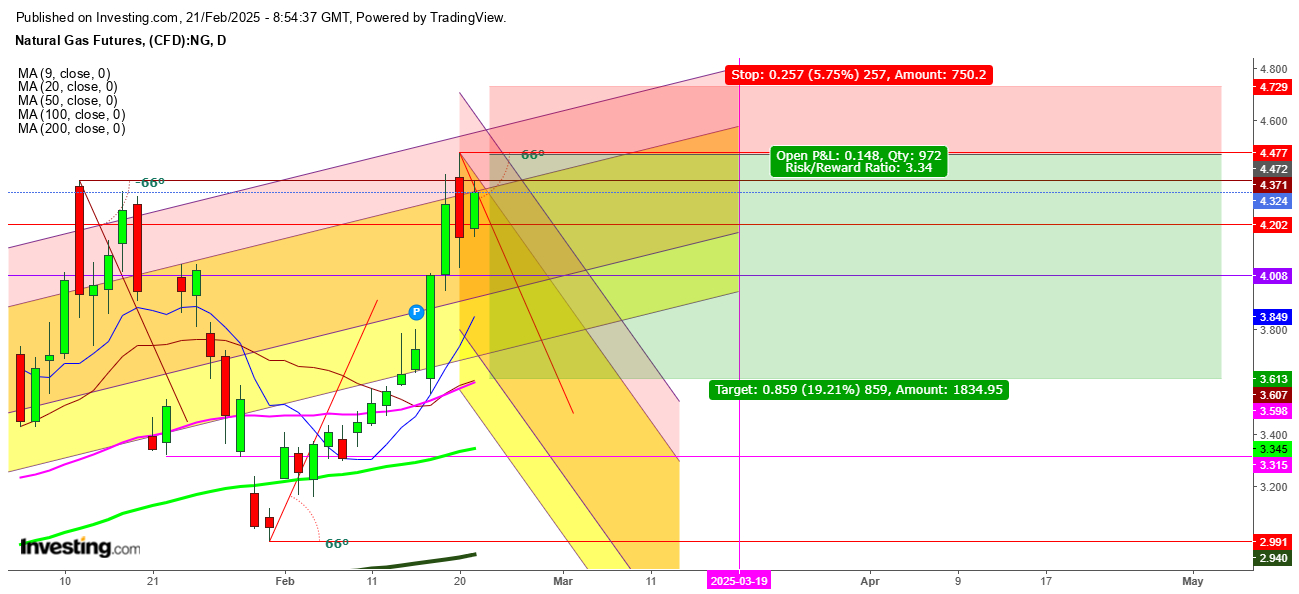 On the daily chart, natural gas futures are facing stiff resistance at the immediate resistance at $4.371 indicates if the natural gas could not sustain above this, bears will take the command to trigger a selling spree till today&rsquo s closing. However, if the natural gas futures hit immediate support at $4 likely to result in a sharp reversal despite the thick presence of bears at this level. If the natural gas futures find a breakdown below this significant support, the next support will be at the 9 DMA at $3.850. Inversely, in case of a breakout by the natural gas futures above the next resistance at $4.477 will provide a good opportunity to take a short position with a stop loss at $4.729 for a target at $3.613. |
||||
| Useful To Me Not Useful To Me | |||||
|
ysh2006
Supreme |
21-Feb-2025 20:21
|
||||
|
x 0
x 0 Alert Admin |
When the result out ? Shortist will out to sabotage price and we caught losing price like Seatrium. | ||||
| Useful To Me Not Useful To Me | |||||