


| Latest Forum Topics / Others |
 Post Reply Post Reply
|
|
STI 3,000 boosted by pivot investors mkt players
|
|||||||||||||||||||||||||||||||||||||
|
GorgeousOng
Supreme |
10-Jun-2014 09:45
Yells: "Hehehaha...enjoy life n live to the fullest..." |
||||||||||||||||||||||||||||||||||||
|
x 0
x 0 Alert Admin |
China May CPI up 2.5 % Hapi Hapi Trading! |
||||||||||||||||||||||||||||||||||||
| Useful To Me Not Useful To Me | |||||||||||||||||||||||||||||||||||||
|
WanSiTong
Supreme |
10-Jun-2014 06:31

|
||||||||||||||||||||||||||||||||||||
|
x 0
x 0 Alert Admin |
Published June 10, 2014
STOCKS
ST Index hits one-year high
Upbeat US jobs report and Japan first-quarter GDP data spur positive start to the week
 THE local bourse' s key index hit its highest level in a year yesterday, fuelled by a solid jobs report from the US and Japan' s encouraging first- quarter GDP data. It marked a positive start to a week that is likely to be devoid of any major event on the global economic calendar. The Straits Times Index (STI) rose 5.77 points or 0.2 per cent to 3,305.2 yesterday. Gains across other major regional bourses were higher. Japan' s Nikkei 225 put on 0.3 per cent while Hong Kong' s Hang Seng jumped 0.7 per cent. Wall Street' s record close last Friday, led by May data which showed an all-round improvement in US jobs indicating better economic momentum in the world' s largest economy, proved enough to galvanise the stock market. " All of the jobs lost during the recession have now been regained, although the growing labour force means that the economy is still some way from full employment," said the Bank of Singapore' s chief economist, Richard Jerram. Yet, as he pointed out, there are conflicting measures on the amount of slack still left in the labour market which could be a problem for the Federal Reserve when deciding how long to stick with its zero interest rate policy. |
||||||||||||||||||||||||||||||||||||
| Useful To Me Not Useful To Me | |||||||||||||||||||||||||||||||||||||
|
|
|||||||||||||||||||||||||||||||||||||
|
WanSiTong
Supreme |
10-Jun-2014 06:27
|
||||||||||||||||||||||||||||||||||||
|
x 0
x 0 Alert Admin |
Published June 10, 2014
Dark condos shine light on rising vacancy
Suburban areas worst hit softening rentals seen
 As dusk descends upon the Singapore skyline, the excess capacity building up in the private housing market is evident. Dark patches in some condominium developments completed six to 12 months ago, or even longer, point to significant vacancy - PHOTO: REUTERS [SINGAPORE] As dusk descends upon the Singapore skyline, the excess capacity building up in the private housing market is evident. Dark patches in some condominium developments completed six to 12 months ago, or even longer, point to significant vacancy. Analysts cite a host of factors, including strong investment demand for real estate after the global crisis, escalation in private home completions of late, and slower expatriate inflow. Vacancies are set to climb and rents fall in general. Suburban locations, where most of the supply is, will be the worst hit. " If increasingly there are a lot of empty units," says Lee Lay Keng, DTZ regional head (SEA) research, " it could indicate we' re not making the best use of our limited land resources." After the global crisis, investors sought refuge in trusty assets such as real estate. Fuelled by the low interest rate environment, some took to hoarding property at new launches and are hence not bothered whether they can find a tenant after taking possession of their units, say observers. Some high net worth foreign buyers treat their Singapore property as a holiday home and leave it unoccupied most of the time. But there are others who leave units vacant because they are not able to find tenants. As Ms Lee notes: " Competition for tenants is increasingly intense, with both demand and supply factors at work. On the demand side, changes in labour policies have slowed down the flow of foreign professionals into Singapore while on the supply side, there is a higher-than-average number of private home completions." JLL national director Ong Teck Hui highlights that " those who bought for rental returns would find themselves in a more competitive leasing market today, where units in mediocre locations would be more difficult to lease and therefore remain vacant for a longer duration, especially during this period of strong supply" . Ku Swee Yong, CEO of Century 21, explains that those who acquired private homes, say in 2010, would already be sitting on profits. " If they bought for capital gains, they may prefer to keep their unit empty rather than rent it out because it is quite usual for a fresh tenant to have a clause in the lease agreement protecting them from viewings by the landlord in the first six or even 12 months." R' ST Research director Ong Kah Seng says that, due to low rents, some owners have left their units empty, especially the cash-rich set who did not take any housing loan for their purchase. " A vacant unit may deteriorate faster but leasing it out at a low rent may not be feasible since it will incur high maintenance costs. High-end properties have the finest finishes, so maintenance and repair costs may be hefty. Selected fit-outs and finishings such as tiles may be of limited collection and difficult to replace if it is damaged by the tenant." Developers left with unsold units, especially in the slow high-end segment, also contribute to vacancies as these projects are completed. Other factors may also be at play in specific projects. But the overall trend of rising vacancies and softening rents is clear amid climbing private home completions since last year. The 13,150 private homes that received TOP last year was 27.3 per cent above the previous year' s 10,329 and 40 per cent above the past 10-year average of 9,395. The figure for Q1 this year was 4,114 and the full-year tally is expected to hit 17,138, based on estimates submitted by developers to the Urban Redevelopment Authority. Thereafter, completions are slated to climb further to 21,738 next year and 26,252 in 2016 before easing the following year. URA figures show that the pool of vacant private homes has risen to 19,284 at end-Q1 2014 from 18,003 at end-Q4 2013 and 14,532 at end-Q1 2013. The islandwide vacancy rate rose to 6.6 per cent at end-Q1 this year from 6.2 per cent a quarter earlier and 5.2 per cent at end-Q1 2013. CBRE executive director (residential) Joseph Tan says that the latest quarter' s increase could be due partly to families that had yet to move to the new homes that were completed in Q1. Rising vacancies have been accompanied by softening rentals. For the first time since Q3 2009, URA' s private home rental index contracted in Q4 last year. The index dipped 0.5 per cent quarter-on-quarter, followed by a further 0.7 per cent drop in Q1. CBRE predicts a 5-8 per cent drop in rents generally this year. JLL predicts a 4-8 per cent decline Century 21' s Mr Ku reckons competition for tenants will drive rents down by 8-10 per cent, followed by a further drop of up to 25 per cent in 2015. Against the backdrop of the large supply, says DTZ' s Ms Lee, some landlords could become more flexible on their rents, particularly after the removal of the vacancy tax refund with effect from Jan 1, 2014. " Landlords now have to pay property tax on their vacant units and some may accept a lower rent and have the unit rented out instead of leaving it empty." This could create downward pressure on rents. JLL' s Mr Ong predicts the vacancy rate could be around 7-9 per cent at end-2014. Mr Ku reckons vacancy will head towards 7.5-8 per cent mid to late next year, adding that price drops are likely to be limited to 5-10 per cent per year - assuming the economy is fine. Competition for tenants is likely to be more intense in suburban projects, as the bulk of completions last year as well as the potential supply pipeline are in Outside Central Region (OCR). URA' s Q1 rental index for non-landed private homes in OCR was down 2.3 per cent from a year ago. This compares with a decline of 0.3 per cent for Core Central Region (CCR) and a rise of one per cent in Rest of Central Region (RCR). Of the 67,507 homes under construction at end-Q1, about 59 per cent were in OCR, 22 per cent in RCR and 19 per cent in CCR. Four years earlier, of the slightly over 36,000 units under construction, the respective shares were 30, 36 and 34 per cent, notes JLL' s Mr Ong. " The heavy buying in OCR in the past few years has resulted in units under construction in this submarket surging 270 per cent over the past four years. While it is true that a high proportion of purchases in OCR is for owner-occupation, the level of investment purchases in the past few years has also been substantial. " Based on rental contracts registered last year, OCR' s share of the leasing market was about 31 per cent. Hence, the disproportionate oncoming supply may be expected to impact on this submarket more significantly." Ms Lee, too, expects a bigger impact on rents and vacancy rates in the suburbs, " although rental demand will still be supported by budget-conscious foreign professionals as the rental quantum for suburban condos is lower than city-fringe or prime condos" . |
||||||||||||||||||||||||||||||||||||
| Useful To Me Not Useful To Me | |||||||||||||||||||||||||||||||||||||
|
WanSiTong
Supreme |
10-Jun-2014 06:03
|
||||||||||||||||||||||||||||||||||||
|
x 0
x 0 Alert Admin |
Markets OverviewMonday Close:
Big deals drive stock market higher The good news for investors: Stocks finished Monday higher -- meaning new record closes for the Dow Jones Industrial Average and S& P 500.But it was a glass half-empty kind of day: The gains were very modest with the Dow up just under 19 points (0.11%) and the S& P 500 a mere 0.09%. The Nasdaq finished the session 0.3% higher. While stocks are climbing to new highs, volatility -- or " fear" -- in the market is back at the lowest levels since 2007. The Chicago Board Options Exchange' s VIX index fell below 11 Friday for the first time since before the financial crisis. It crept back above 11 today.
Related: Calm before the storm? Volatility at a seven-year low. International stocks: European markets finished slightly higher, with the FTSE 100 closing up around a quarter of a percent. Asian markets all ended with gains. The Nikkei in Japan rose by 0.3% after official GDP figures for the first quarter were revised to show the economy grew at a stronger than expected rate of 1.6% compared to the last quarter of 2013. The previous estimate for GDP growth was 1.5%. |
||||||||||||||||||||||||||||||||||||
| Useful To Me Not Useful To Me | |||||||||||||||||||||||||||||||||||||
|
Isolator
Supreme |
10-Jun-2014 00:33

|
||||||||||||||||||||||||||||||||||||
|
x 0
x 0 Alert Admin |
Bluechips will still run up but slower pace... Penny will rally back to their glory high in fast track... Gold will continue to slide to 900..., enjoy.. | ||||||||||||||||||||||||||||||||||||
| Useful To Me Not Useful To Me | |||||||||||||||||||||||||||||||||||||
|
|
|||||||||||||||||||||||||||||||||||||
|
teeth53
Supreme |
09-Jun-2014 23:03
Yells: "don't learn through life, learn to grow with life " |
||||||||||||||||||||||||||||||||||||
|
x 0
x 0 Alert Admin |
STI bull running, then is penny stocks turn, today making green wave after wave. |
||||||||||||||||||||||||||||||||||||
| Useful To Me Not Useful To Me | |||||||||||||||||||||||||||||||||||||
|
WanSiTong
Supreme |
09-Jun-2014 21:00
|
||||||||||||||||||||||||||||||||||||
|
x 0
x 0 Alert Admin |
Published June 09, 2014
Singapore' s private resale transactions, prices fall in May
 Resale transactions of non-landed private homes fell 7.5 per cent month-on-month in May to an estimated 421, while resale prices continued to inch down by 0.3 per cent to stay at a 17-month low - PHOTO: SPH RESALE transactions of non-landed private homes fell 7.5 per cent month-on-month in May to an estimated 421, while resale prices continued to inch down by 0.3 per cent to stay at a 17-month low.
On a year-on-year basis, resale volume fell 42.6 per cent drop (from 734 units resold in May 2013), flash figures released by the Singapore Real Estate Exchange (SRX) on Monday showed. Prices in the core central region (CCR) led the fall with a 2.9 per cent decline, followed by a 0.3 per cent drop in the city fringes, while prices in suburban areas inched up by 0.6 per cent The median Transaction Over X-value (TOX) stayed negative at -S$10,000 for the non-landed private resale market in May, meaning that most buyers last month bought their units below what other buyers who came before them paid for similar units. |
||||||||||||||||||||||||||||||||||||
| Useful To Me Not Useful To Me | |||||||||||||||||||||||||||||||||||||
|
WanSiTong
Supreme |
09-Jun-2014 09:06
|
||||||||||||||||||||||||||||||||||||
|
x 1
x 1 Alert Admin |
Published June 09, 2014
China' s stronger exports in May cushion slowdown
 China' s exports rose more than analysts estimated last month, helping to cushion a slowdown in the world' s second-biggest economy as an unexpected slump in imports highlights the risks to growth. - PHOTO: REUTERS [BEIJING] China' s exports rose more than analysts estimated last month, helping to cushion a slowdown in the world' s second-biggest economy as an unexpected slump in imports highlights the risks to growth. Overseas shipments gained 7 per cent from a year earlier, the Beijing-based customs administration said yesterday. Imports fell 1.6 per cent. The trade surplus widened to US$35.92 billion. Stronger exports may bolster Chinese leaders' confidence that a recovery in demand from the US and Europe will support economic growth and reduce pressure on the government to counter domestic weakness with stronger stimulus as the property market slumps. The European Central Bank' s unprecedented easing last week is a welcome step for China that should help export growth, World Bank economist Karlis Smits said on Friday. " The export figures are positive news for policymakers and we expect continued solid export growth in the coming months amid gradually improving global demand momentum," said Louis Kuijs, chief China economist at Royal Bank of Scotland in Hong Kong. " The import data suggest a pretty subdued state of the domestic economy though and the dilemma for the government is how to balance the need to reduce growth in leverage with all the calls for support." |
||||||||||||||||||||||||||||||||||||
| Useful To Me Not Useful To Me | |||||||||||||||||||||||||||||||||||||
|
|
|||||||||||||||||||||||||||||||||||||
|
Tempest
Master |
09-Jun-2014 09:06
|
||||||||||||||||||||||||||||||||||||
|
x 0
x 0 Alert Admin |
China Bull market set off today! Buy S CHIP counters now!! HUAT ah!! |
||||||||||||||||||||||||||||||||||||
| Useful To Me Not Useful To Me | |||||||||||||||||||||||||||||||||||||
|
WanSiTong
Supreme |
09-Jun-2014 08:52
|
||||||||||||||||||||||||||||||||||||
|
x 0
x 0 Alert Admin |
Published June 09, 2014
WALL STREET INSIGHT
Stock bulls face two headwinds now
LAST week, US stocks finished at record highs as a rate cut from the European Central Bank (ECB) and a strong jobs report gave stock bulls a second wind. The momentum of the latest bull run could carry the market higher for another week. Having closed less than 100 points away, the Dow Jones Industrial Average is almost sure to test the 17,000 level. If they are to run much further, however, the bulls must fight two headwinds: valuation and rising interest rates. As anticipated, the ECB cut deposit rates for banks below zero, effectively making it cheaper for lenders to give loans than to sit on reserves. This sparked the late-week rally, and the jobs report supported it. A higher-than-forecast 217,000 jobs were added to payrolls in May and the unemployment rate held steady at 6.3 per cent. While the four-month aggregate of jobs added was the highest since the 1990s, what observers such as Dallas Federal Reserve president Richard Fisher have called " structural" problems persist. A low participation rate still shows that millions have been left behind in the recovery. Sales reports from major retailers last week suggested that the revival of mall traffic in April lasted through May. This week, the government' s tally of retail sales should confirm modest growth for the month. In another good sign, a survey of home-builder sentiment is expected to show its highest reading since before the Great Recession. |
||||||||||||||||||||||||||||||||||||
| Useful To Me Not Useful To Me | |||||||||||||||||||||||||||||||||||||
|
WanSiTong
Supreme |
08-Jun-2014 10:57
|
||||||||||||||||||||||||||||||||||||
|
x 0
x 0 Alert Admin |
Why hasn' t Main Street recovered like Wall Street? 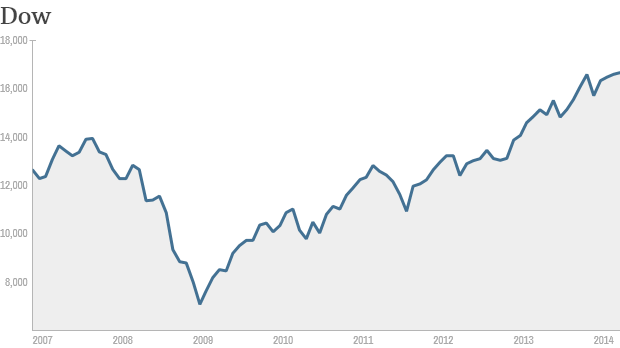 If the five-year recovery from the Great Recession were a stereotypical college party, Wall Street would be the cool jocks drinking beers while everyday Americans would still be waiting for their invitations.Frustration over the uneven economic rebound is understandable. Stock prices have nearly tripled from their lows in 2009 and continue to shatter records. Meanwhile, the " real" economy remains painfully pedestrian. Why have the past five years only increased the divide between Main Street and Wall Street? Look no further than the Federal Reserve stimulus measures. " Monetary policy is a blunt instrument, not a surgical tool. It' s much better at inflating assets than creating jobs," said Kristina Hooper, U.S. investment strategist at Allianz Global Investors, which manages nearly $500 billion in assets. Main Street misses the ride up: There' s little question the Fed has been among the biggest forces behind the Dow' s 10,000-point climb. With banks scared to lend and Congress unwilling or unable to inject additional fiscal stimulus, Ben Bernanke & Co. were left with little choice but to unleash monetary policy. The Fed' s moves stabilized the financial system and encouraged bigger investors to get back into the market since putting money in the bank yielded almost no interest. Of course, many Mom and Pop investors had already cashed out as they watched their retirement funds evaporate. While hedge funds and billionaires scooped up beaten down stocks, less affluent Americans didn' t have the tolerance or resources to buy companies like Apple (AAPL) at truly historic discounts in 2009. In fact, fewer Americans have money invested in the stock market now than a decade ago, according to Gallup. CNNMoney wants to know: Did you benefit from the big stock market rise? " Only a small group has participated in this recovery. While we have made a lot of progress, it has been unevenly distributed," said Hooper. Sluggish job, wage growth: Corporate America is also operating at extremely lean levels as the memories of the crisis linger. That means some companies like Hewlett-Packard (HPQ) continue to cut costs -- a business way of saying eliminating tens of thousands of people' s jobs. 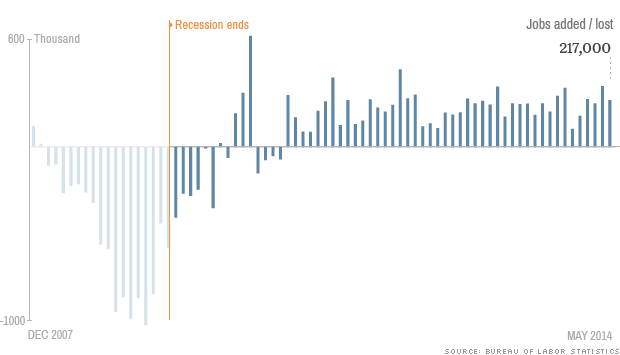
The U.S. has almost recovered the jobs lost in the Great Recession, but it' s been a slow rebound. While companies are always expanding or contracting, the hiring hasn' t kept up with the job trimming. Businesses simply expect the remaining employees to work harder. All of this explains why some parts of the economy have returned to their pre-recession levels, private sector employment has not. Even more alarming, many of the jobs that are created pay less than the ones lost during the recession. Real average hourly earnings for all U.S. employees decreased 0.3% in April from March. Some companies are also scared to spend due to a lack of visibility over regulatory, health care and tax policies out of Washington. " There is a vast array of uncertainty, which impedes the ability to plan. It' s tough to navigate in a fog -- and that' s what has descended on businesses in America," said Lawrence Creatura, vice president and portfolio manager at Federated Investors. Related: U.S. economy hits 5-year mark, but long way to go Corporate America hoards cash: While many companies have done well since 2009, returning to record profitability, they have been cautious in their spending. Non-financial S& P 500 companies are sitting on an eye-popping $1.4 trillion of cash at the end of 2013, according to FactSet. Normally companies would invest that money in new projects -- and the new equipment, factories and hires that comes with that. But they don' t have the courage of incentives to deploy their cash right now. Despite the fact that stocks climbed to record highs, capital expenditures fell by 4% in the fourth quarter of last year and inched up a meager 0.3% in 2013. That' s down from annual growth rates of 10.5% in 2012 and 39.7% in 2011, FactSet said. What little cash CEOs are spending is going into shareholder-friendly moves like stock buybacks that don' t do much to stimulate broader economy. " Management teams are now Pavlonian beings. They know exactly how to respond when they get increased cash flows: higher dividends and more buybacks," said Creatura. Income inequality deepens: The uneven nature of the current recovery has only added to the growing problem of income inequality in one of the world' s wealthiest countries. Pay data from Equilar shows CEOs now make about 257 times the average worker, up from 181 times in 2009. If there' s one somewhat bright spot for Main Street, it' s that the recession wasn' t worse. And the slow nature of the current recovery increases the chances it can continue chugging along before the inevitable next downturn. " We could potentially see this type of recovery be one that continues for a while and enables those that haven' t participated to catch up," said Hooper. |
||||||||||||||||||||||||||||||||||||
| Useful To Me Not Useful To Me | |||||||||||||||||||||||||||||||||||||
|
teeth53
Supreme |
08-Jun-2014 10:56
Yells: "don't learn through life, learn to grow with life " |
||||||||||||||||||||||||||||||||||||
|
x 0
x 0 Alert Admin |
REIT Dividend play yield is among the highest pay out - Close to 50 major counters are paying out yields of above 3% http://www.topyields.nl/Top-dividend-yields-of-STI.php STI mkt value-weighted stk mkt index based on the stocks of 30 representative companies listed on the SGX-ST Last updated: 2014/6/6 (Cannot match OUE HTrust) |
||||||||||||||||||||||||||||||||||||
| Useful To Me Not Useful To Me | |||||||||||||||||||||||||||||||||||||
|
|
|||||||||||||||||||||||||||||||||||||
|
luminol
Senior |
08-Jun-2014 07:06

Yells: "Correlation does not imply causation." |
||||||||||||||||||||||||||||||||||||
|
x 0
x 0 Alert Admin |
STI hasn' t realised its full potential yet. Still cheap to buy.
|
||||||||||||||||||||||||||||||||||||
| Useful To Me Not Useful To Me | |||||||||||||||||||||||||||||||||||||
|
marubozu1688
Master |
07-Jun-2014 23:33
Yells: "Be humble in front of Mr. Market." |
||||||||||||||||||||||||||||||||||||
|
x 0
x 0 Alert Admin |
STI PE at 13.92, PB at 1.37 http://mystocksinvesting.com/stock-market-indices-pe-ratio/global-stock-market-indices-pe-ratio-at-a-glance-7-june-2014/ |
||||||||||||||||||||||||||||||||||||
| Useful To Me Not Useful To Me | |||||||||||||||||||||||||||||||||||||
|
WanSiTong
Supreme |
07-Jun-2014 07:44
|
||||||||||||||||||||||||||||||||||||
|
x 0
x 0 Alert Admin |
Eat today ! Huat arh...
|
||||||||||||||||||||||||||||||||||||
| Useful To Me Not Useful To Me | |||||||||||||||||||||||||||||||||||||
|
bishan22
Supreme |
07-Jun-2014 07:40
|
||||||||||||||||||||||||||||||||||||
|
x 0
x 0 Alert Admin |
Monday eat green kueh again. Wohoooo. | ||||||||||||||||||||||||||||||||||||
| Useful To Me Not Useful To Me | |||||||||||||||||||||||||||||||||||||
|
WanSiTong
Supreme |
07-Jun-2014 07:07
|
||||||||||||||||||||||||||||||||||||
|
x 1
x 1 Alert Admin |
Published June 07, 2014
China growth to ease to 7.6%: World Bank
IMF forecast the country' s growth to be around 7.5% this year
 CHINA' S economic growth is expected to ease slightly to 7.6 per cent this year from 7.7 per cent in 2013 and to moderate further to 7.5 per cent next year, the World Bank said yesterday while cautioning that structural transformation of the world' s second largest economy is unlikely to be an even process - PHOTO: AFP CHINA' S economic growth is expected to ease slightly to 7.6 per cent this year from 7.7 per cent in 2013 and to moderate further to 7.5 per cent next year, the World Bank said yesterday while cautioning that structural transformation of the world' s second largest economy is unlikely to be an even process.
" The rebalancing is not smooth, and quarterly growth is volatile," the World Bank noted in its latest China Economic Update. Recent data suggest, however, that " growth has stabilised and growth momentum is expected to accelerate in the second quarter of 2014" . The World Bank report came a day after the International Monetary Fund published the results of a regular economic consultation with Chinese authorities in which the IMF forecast that China' s growth should be around 7.5 per cent this year, but could slip to 7 per cent in 2015. The IMF said bluntly that " activity in China since the global financial crisis has been too dependent on credit and investment, including in real estate. While this has supported growth and provided a boost to global demand, it is not sustainable and (creates) rising vulnerabilities." Both institutions expressed overall confidence in the China' s ability to achieve a controlled slowdown or soft landing while also pointing to a series of risks. " Recent growth rates (in China) have been significantly below levels observed over the past decade as drivers of economic growth shift from manufacturing to services on the supply side, and from investment to consumption on the demand side," the World Bank said in its update. The growth slowdown in the first quarter of this year " reflected a combination of dissipating effects of earlier growth-support measures, subdued external environment, and tighter credit, especially for real estate activities" . In recent months, however, economic activity, including industrial production has started to show signs of acceleration, the World Bank said. This is " expected to continue into the next two quarters of this year - partly reflecting the effect of new growth-supporting measures, robust consumption, and a recovery of external demand" . A planned decline in Chinese investment growth will be largely offset by a gradual increase in consumption growth, supported by an increase in household incomes, the World Bank said. " The fundamental drivers of the global recovery remain intact and should provide a favourable tailwind to China' s net export growth. However, headwinds from a gradual deceleration of credit growth can be expected to weigh on domestic economic activity." The World Bank said that the main channels of a possible disorderly unwinding are related to local government financing, which in case of a disorderly deleveraging could trigger a sharp slowdown in investment growth, and to prospects of sectors such as real estate, which in case of an abrupt change in the cost of capital could result in debt service difficulties. It called for fiscal and financial sector reforms to address financial stability risks in the medium term. The first task involves effectively managing rapid credit growth, including the less well-regulated shadow banking system. " The second, gradual and orderly deleveraging of large stock of local government debt accumulated through off-budget and quasi-fiscal platforms. Both of these reforms could potentially be disruptive to growth in the short run." The IMF said, meanwhile, that activity in China since the global financial crisis " has been too dependent on credit and investment, including in real estate" . |
||||||||||||||||||||||||||||||||||||
| Useful To Me Not Useful To Me | |||||||||||||||||||||||||||||||||||||
|
WanSiTong
Supreme |
07-Jun-2014 07:04
|
||||||||||||||||||||||||||||||||||||
|
x 0
x 0 Alert Admin |
Published June 07, 2014
Unsold homes big drag on developers' coffers
Punishing fees seen incentivising some to reprice projects to move sales in near term
 DEVELOPERS have collectively paid up to $55.1 million in extension fees for unsold units in their private condo projects since 2012. They could potentially fork out another $80.7 million to extend the sales period for another year if they do not sell their inventory by year-end, according to a study by OrangeTee Research - PHOTO: ST
DEVELOPERS have collectively paid up to $55.1 million in extension fees for unsold units in their private condo projects since 2012. They could potentially fork out another $80.7 million to extend the sales period for another year if they do not sell their inventory by year-end, according to a study by OrangeTee Research. " As the penalty amounts to millions of dollars per project, we believe that it will incentivise some developers to reprice some of these projects to move sales in the near term," said OrangeTee research head Christine Li. A total of 24 condo projects, mostly high-end ones, are still not fully sold two years after receiving their temporary occupation permits (TOPs) between 2010 and 2012, the study showed. Under the government' s Qualifying Certificate (QC) rules, developers have to pay extension charges to extend the sales period after two years of the project' s TOP. All developers with non-Singaporean shareholders or directors need to obtain QCs to buy private land for new projects because they are deemed " foreign developers" under the Residential Property Act (RPA). This means the QC rules apply to all listed developers. Privately owned Far East Organization and Hoi Hup are among the few developers exempted from the rules. Given that the QCs allow developers up to five years to finish building a project and two more years to sell all the units, the heat is on developers to clear their stock by the deadline. To extend the sales period, developers pay 8 per cent of the land purchase price for the first year of extension, 16 per cent for the second year and 24 per cent from the third year onwards. The charges are pro-rated based on unsold units over the total units in the project. Such fees drove luxury residential player SC Global to delist from the Singapore Exchange last year after sales slowed significantly due to the government' s property cooling measures. Analysts warn that more extension charges will kick in. The charges paid up so far are just the tip of the iceberg as projects built from land acquired during the 2006-2007 en bloc fever have just crossed a seven-year mark, they say. " More developers are caught between a rock and a hard place" as they have to decide whether to pay the extension charges or cut prices to move the units, said SLP International executive director Nicholas Mak. If they pay for extension charges, there is also the question of whether they can recover these costs later on, he said. This is why some developers of luxury projects are resorting to selling the units in bulk to mega investors. OrangeTee' s study of the 24 projects excluded three projects whose land costs could not be determined. It tracked sales of projects through caveats lodged, which it conceded could be lower than actual sales. At the end of the first quarter of this year, there were 10,295 unsold units in the Core Central Region (CCR), 8,089 in the Rest of Central Region (RCR) and 12,433 in the Outside Central Region (OCR). Based on URA caveats, there are 71 unsold units in Wheelock Properties' Scotts Square that TOP-ed in 2011 and 16 unsold units in Wing Tai' s Helios Residences, which also TOP-ed in the same year. " As unsold inventory builds up, there will likely be more bargains in the market if developers want to avoid paying penalties to extend the sales period, especially high-end developers who have already paid premium prices for their lands," Ms Li said. The study excluded the fees that developers need to pay to extend the completion of projects beyond five years, as they can typically extend without paying the charges " based on technicalities" . Even in a more optimistic scenario where developers manage to sell 20 per cent of the remaining units for the rest of this year, further extension charges to be paid by developers by end-2014 will amount to around $68.3 million. Some market watchers noted that the QC rules should mark a distinction between larger and smaller projects, given that it takes a longer time to move all the units in large projects in a difficult market as the current one. Century21 chief executive officer Ku Swee Yong said that demand for high-end projects had been hit hardest by higher additional buyers' stamp duty (ABSD) since January 2013 and a borrowing cap under the total debt servicing ratio (TDSR) since June last year. Even if a developer decides to set up an investment company to buy the units and rent them out, the company could be hit by a 15 per cent ABSD and is restricted by a loan-to-value limit of 20 per cent. While there is good reason for having QC rules to regulate foreign participation in the housing market, these rules were in place before the ABSD and TDSR. " It is about time we review these measures," Mr Ku said. |
||||||||||||||||||||||||||||||||||||
| Useful To Me Not Useful To Me | |||||||||||||||||||||||||||||||||||||
|
WanSiTong
Supreme |
07-Jun-2014 06:53
|
||||||||||||||||||||||||||||||||||||
|
x 0
x 0 Alert Admin |
Stock market starts weekend off right 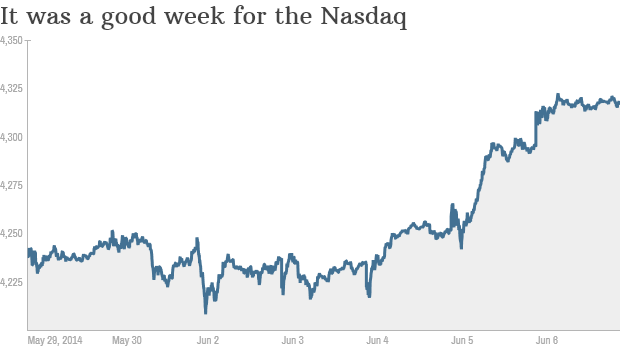
This is how to start your Friday off right: More money in your stock portfolio.The stock market once again closed at record levels thanks to a stronger-than-expected jobs report on Friday morning. The Dow Jones Industrial Average, S& P 500 and Nasdaq Composite all closed about half a percent higher for the day, with the Dow hitting 16,924.28 and the S& P 500 ending at 1,949.44.
This week has been a strong one overall for the markets. All three of the major indexes have gained at least 1%. The Nasdaq is up over 1.8% as tech stocks continue to rebound from the spring sell-off. " The US economy says please have a quiet and enjoyable weekend," wrote Societe General' s Kit Juckes in a note to investors. Related: Oh, the places you' ll go (for yield)! Jobs! Lots of ' em: Things are looking good in the job market. The government said the U.S. economy created 217,000 jobs last month, more than the 200,000 expected by economists polled by CNNMoney. That' s not as much as the 282,000 jobs created in April, but it' s enough to get America back to where the labor market was before the recession. The unemployment rate also held steady at 6.3%. Now, the economy needs to create enough jobs for the additional folks who have joined the labor force since then. Related: Has your stock portfolio recovered since the financial crisis? International markets: European markets did well on Friday, led by a 1.7% rise in Spain, as the ECB' s stimulus package continued to bolster appetite for riskier assets. London' s FTSE 100 climbed about 0.7%. The euro slipped slightly against the dollar. Asian stocks were mixed. Chinese and Japanese stocks were modestly lower, but India' s Sensex is still enjoying its Modimoon, closing up 1.5%. |
||||||||||||||||||||||||||||||||||||
| Useful To Me Not Useful To Me | |||||||||||||||||||||||||||||||||||||
|
teeth53
Supreme |
06-Jun-2014 22:32
Yells: "don't learn through life, learn to grow with life " |
||||||||||||||||||||||||||||||||||||
|
x 0
x 0 Alert Admin |
The credit profiles of Singapore real estate investment trusts (REITs) are expected to remain stable over the next 12 to 18 months, according to a Fitch Ratings report. Using the financial results of 29 of the 31 REITs listed in Singapore, Fitch found that their loans to property value ratios are way below the regulatory limit of 40 percent, while their unencumbered assets were more than enough to cover their unsecured creditors. Moreover, the REITs also have healthy funds from operation (FFO) interest coverage, at 4.8x in 2013, up from 2012' s 4.1x. These mitigate the high leverage of the sector, which was sustained by the SREITs due to low interest rates as well as rising asset values. |
||||||||||||||||||||||||||||||||||||
| Useful To Me Not Useful To Me | |||||||||||||||||||||||||||||||||||||
